


Two steps are all it takes to start. Pick your CIMAPRO19-P02-1 product at Real4Prep, complete the secure payment, and your materials land in your email almost at once — in 2026, preparing for the CIMA Advanced Management Accounting really can be that simple.
CIMA CIMAPRO19-P02-1 Exam Overview:
| Certification Vendor: | CIMA (Chartered Institute of Management Accountants) |
|---|---|
| Exam Name: | P2 Advanced Management Accounting |
| Exam Number: | CIMAPRO19-P02-1 |
| Available Languages: | English |
| Real Exam Qty: | 60 |
| Passing Score: | 70% |
| Exam Duration: | 90 minutes |
| Related Certifications: | CGMA Designation Operational Level Diploma Strategic Level Qualification |
| Certificate Validity Period: | 7 years from registration to complete level; permanent once awarded subject to CPD |
| Exam Format: | Multiple Choice, Computer-based Objective Test, Multiple Response, Number Entry, Drag and Drop |
| Exam Price: | Approx £115 / $155 USD / €135 (varies by region) |
| Recommended Training: | Astranti CIMA CIMA Official Study Resources Kaplan Learning |
| Exam Registration: | CIMA Official Registration Pearson VUE Scheduling |
| Sample Questions: |  |
| Exam Way: | On-demand computer-based test; available at Pearson VUE test centres or online remote proctoring |
| Pre Condition: | Completion of Operational Level (E1, P1, F1) or eligible exemptions; registered CIMA student |
| Official Syllabus URL: | https://www.cimaglobal.com/study-support/syllabus-and-exams/p2/ |
CIMA CIMAPRO19-P02-1 Exam Syllabus Topics:
| Section | Weight | Objectives |
|---|---|---|
| Topic 1: Managing Performance of Organisational Units | 30% | - Performance measurement and control
|
| Topic 2: Managing the Costs of Creating Value | 20% | - Cost management techniques
|
| Topic 3: Capital Investment Decision Making | 35% | - Investment appraisal methods
|
| Topic 4: Risk and Control | 15% | - Risk assessment and management
|
Common Questions About CIMA Advanced Management Accounting and Real4Prep
The CIMA Advanced Management Accounting blueprint breaks down into these main domains:
- Risk and Control (15%)
- Capital Investment Decision Making (35%)
- Managing the Costs of Creating Value (20%)
Additional domains follow in the official outline, and our question bank covers every one of them.
Right after payment, your download link is available instantly and an automatic email with the materials reaches your inbox in about a minute — you can download the attachments whenever it suits you and install the software on as many machines as you need. If nothing arrives within two hours, contact our support team and we will sort it out. Your purchase also includes 365 days of free updates, sent to your email as soon as a new version is ready; when the period ends, you can renew at a 50% discount.
You can register through the official channels below:
Pick the option that suits you, choose a test center or an online slot, and book early — popular dates fill up fast.
Based on the latest exam information, the CIMAPRO19-P02-1 exam contains 60 questions and gives you 90 minutes minutes to complete them. Practicing under the same time limit in our PC or online version is a good way to assess your pace before the real thing.
CIMA lists the following prerequisites for the CIMA Advanced Management Accounting: Completion of Operational Level (E1, P1, F1) or eligible exemptions; registered CIMA student.
You can verify the details on the official certification page.
If you fail the corresponding exam within 60 days of your purchase, we will refund you in full. Simply send a scanned copy of your enrollment slip and your official Score Report PDF within two days of taking the exam; we process verified claims within seven days. A few conditions apply: exams taken within three days of purchase are not covered, the candidate name must match the payer, and free or expired products are excluded. If you would rather keep preparing, we can exchange your product for two others of equal value instead.
CIMA suggests the following official training options:
These courses pair well with hands-on question practice if you want a structured path through the material.
Because it was built for people with little time to spare. The bank covers the important knowledge points of the current CIMA Advanced Management Accounting blueprint with expert-verified answers, and you study in the format that fits you: a printable PDF you can mark up with a pen, or PC and online versions that simulate the real exam interactively and let you assess your pace. A free demo lets you confirm the quality before you buy, and every purchase includes 365 days of free updates plus a 50% renewal discount afterward.
The current passing score for the CIMAPRO19-P02-1 exam is 70%, and the exam fee is Approx £115 / $155 USD / €135 (varies by region). Fees and cut scores are set by CIMA, so confirm the latest figures on the official page before you register.
CIMA Advanced Management Accounting Sample Questions:
A manufacturing company has just developed a new product and must now determine the most appropriate pricing strategy for its initial launch.
The product will initially be unique because it will include highly desirable features that no competitive product offers. Its development has involved substantial expenditure and the company wishes to recover this as soon as possible.
The product's uniqueness is expected to last for only six months before a competitor launches a similar product. It is expected that the competitor will avoid any significant development costs by reverse engineering the company's own product.
At that point, to remain competitive, the company must ensure that its selling price matches that of the competitor.
Which of the following pricing strategies would be most suitable for the initial launch of the company's product?
- A. Dual pricing
- B. Penetration pricing
- C. Market skimming
- D. Own label pricing
Correct Answer: C 🗳️
A public sector service organization is considering whether to use a balanced scorecard or a value for money approach based on the three Es to assess its performance.
Which of the following are correct comparisons of the balanced scorecard and value for money based on the three Es as performance measurement frameworks?
Select ALL that apply.
- A. If the organization wishes to consider both financial and non-financial performance then the balanced scorecard should be used rather than the three Es.
- B. The public's satisfaction with the organization's services can be measured by both the three Es and the balanced scorecard.
- C. The three Es approach was designed for public sector service organizations, but the balanced scorecard approach can also be used in the public sector.
- D. The balanced scorecard is concerned with meeting the organization's objectives whereas the three Es approach is concerned only with reducing costs.
- E. Efficiency is measured as one of the three Es but the balanced scorecard does not measure efficiency.
Correct Answer: B,C 🗳️
A large manufacturing company sells a range of products. Details of one of these products are as follows.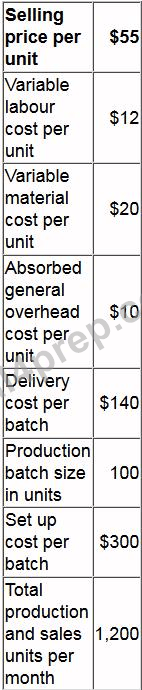
Each completed batch is delivered immediately in full to the one customer that purchases this product.
The delivery vehicle is currently only 50% full when it makes these deliveries. The customer will accept deliveries of any size.
Managers are considering changing the production batch size to 150 units.
Increased material storage would be needed; this can be rented nearby at a cost of $1,500 per month.
The additional storage facility would enable an increase in the reorder quantity for the materials. As a result a 5% discount would be received on all materials purchased.
Using direct product profitability (DPP), what will be the monthly profit attributable to the product if the production batch size is changed to 150 units?
Give your answer to the nearest whole $.
Correct Answer:
$23780
Which TWO of the following expressions are correct?
- A. 1 + real rate = (1 + inflation rate) / (1 + money rate)
- B. 1 + money rate = (1 + real rate) x (1 + inflation rate)
- C. 1 + inflation rate = (1 + money rate) x (1 + real rate)
- D. 1 + real rate = (1 + money rate) / (1 + inflation rate)
- E. 1 + money rate = (1 + inflation rate) / (1 + real rate)
Correct Answer: B,D 🗳️
In an organization's transfer pricing system the selling division and the purchasing division each record a different price for the same transaction.
This is known as a:
- A. Two part tariff system.
- B. Full cost pricing system.
- C. Marginal cost plus pricing system.
- D. Dual pricing system.
Correct Answer: D 🗳️
Viewing page 1 out of 41 pages.
Viewing questions 1-5 out of 205 questions.


