


Accurate Hot Selling JN0-352 Exam Dumps 2026 Newly Released
Get 100% Authentic Juniper JN0-352 Dumps with Correct Answers
NEW QUESTION # 39
A new network requires multiple topology support. You decide to use IS-IS in this situation. Which three protocol topologies are supported in this scenario? (Choose three.)
- A. anycast
- B. IPv6
- C. IPsec
- D. IPv4
- E. multicast
Answer: B,D,E
Explanation:
IS-IS (Intermediate System to Intermediate System) is a routing protocol that is designed to move information efficiently within a computer network. It supports multiple protocol topologies, including IPv4, IPv6, and multicast.
NEW QUESTION # 40
Which statement about configuring persistent MAC learning is correct?
- A. Persistent MAC learning cannot be configured on redundant trunk groups.
- B. Persistent MAC learning requires 802.1X authentication.
- C. Persistent MAC learning flushes dynamically learned MAC addresses on reboots.
- D. Persistent MAC learning can be configured on access mode interfaces.
Answer: D
NEW QUESTION # 41
What are two characteristics of IS-IS? (Choose two.)
- A. IS-IS is an interior gateway protocol.
- B. IS-IS L1 routers route traffic between areas.
- C. IS-IS L1/L2 routers route traffic between areas.
- D. IS-IS routes use a default preference of 20.
Answer: A,C
Explanation:
IS-IS (Intermediate System to Intermediate System) was designed by ISO as a link-state Interior Gateway Protocol for routing within a single autonomous system, functioning on a hierarchical two-level model conceptually similar to OSPF's areas, which makes the first statement unambiguously correct. Within that hierarchy, Level 1 routers maintain detailed topology information only for their own local area and use a default route toward the nearest Level 2 or Level 1/Level 2 router to reach destinations outside the area; they explicitly do not carry inter-area topology information and therefore cannot route traffic between areas on their own. Routers that participate in both levels simultaneously - Level 1/Level 2 (L1/L2) routers - sit at the area boundary, maintaining a Level 1 database for their local area and a Level 2 database for the backbone, and it is specifically these dual-level routers that stitch inter-area traffic together, forwarding packets from the local area into the Level 2 backbone and vice versa, which confirms the second correct statement. Regarding route preference, Junos assigns distinct default preference (administrative distance) values of 15 for IS-IS Level 1 routes and 18 for IS-IS Level 2 routes - neither of which is 20 - so the preference-value statement is factually incorrect and included as a distractor testing precise knowledge of Junos default protocol preferences. Reference topics: Junos Enterprise Routing - IS-IS, Level 1, Level 2, and L1/L2 Router Roles; Default Route Preference Values.
NEW QUESTION # 42
Which two statements are correct about generated routes? (Choose two.)
- A. Generated routes show a next hop in the routing table.
- B. Generated routes appear in the routing table as static routes
- C. Generated routes require a contributing route.
- D. Generated routes cannot be redistributed into dynamic routing protocols.
Answer: A,C
Explanation:
A is correct because generated routes require a contributing route. A contributing route is a route that matches the destination prefix of the generated route and has a valid next hop. A generated route is only installed in the routing table if there is at least one contributing route available. This ensures that the generated route is reachable and useful. If there is no contributing route, the generated route is not added to the routing table.
B is correct because generated routes show a next hop in the routing table. A generated route inherits the next hop of its primary contributing route, which is the most preferred route among all the contributing routes. The next hop of the generated route can be either an IP address or an interface name, depending on the type of the contributing route. The next hop of the generated route can also be modified by a routing policy.
NEW QUESTION # 43
Which statement describes the purpose of an integrated routing and bridging (IRB) interface on a Juniper Networks EX Series Switch?
- A. It provides a Layer 3 gateway for a specific VLAN.
- B. It removes the need for routing instances.
- C. It replaces the need for trunk ports.
- D. It performs Layer 2 switching across multiple VLANs.
Answer: A
Explanation:
An integrated routing and bridging interface, configured as irb.x on an EX Series switch, is the mechanism that bridges the Layer 2 and Layer 3 forwarding planes for a given bridge domain or VLAN. By assigning an irb logical unit to a VLAN and configuring an IP address on that unit, the switch gains a routable Layer 3 gateway address that hosts within that VLAN can use as their default gateway, enabling traffic destined for other subnets to be routed off the local broadcast domain. Internally, when a frame destined for the gateway's MAC address arrives on any port belonging to that VLAN, the switch's integrated circuitry hands the packet from the Layer 2 bridging domain to the Layer 3 routing engine associated with the corresponding irb interface, and vice versa for the return path - hence the name 'integrated routing and bridging.' IRB does not eliminate the need for routing instances, which remain a separate mechanism for isolating routing tables; it does not itself perform inter-VLAN switching, since switching still happens strictly within a VLAN's own broadcast domain; and it has no relationship to trunk ports, which remain necessary for carrying multiple tagged VLANs between switches. IRB is the standard method for enabling inter-VLAN routing on a single EX Series switch without an external router. Reference topics: Junos Enterprise Switching - Routing VLANs, Configuring Integrated Routing and Bridging.
NEW QUESTION # 44
Which statement is correct about GRE tunnels?
- A. GRE tunnels only support encapsulating IP traffic.
- B. There are 20 bytes of overhead with GRE encapsulation.
- C. GRE tunnels only support encapsulating non-IP traffic.
- D. The time-to-live field in the tunnel payload is decremented during transit.
Answer: D
NEW QUESTION # 45
Your router receives two BGP routes for the same prefix. One route is learned from an IBGP neighbor, and the other route is learned from an EBGP neighbor.
By default, which route will be selected as active in this scenario?
- A. The route learned through IBGP.
- B. The route learned from the neighbor with highest router ID.
- C. The route with the shortest AS-path.
- D. The route learned with the highest next-hop IP address.
Answer: C
Explanation:
Once the two candidate routes have equal route preference and equal local preference (both defaulting to 100 unless modified by policy), the Junos BGP algorithm proceeds to its third decision step, which compares the length of each candidate's AS path attribute and selects whichever path carries the shortest AS path, since a shorter path is interpreted as traversing fewer autonomous system hops to reach the origin. This step occurs well before the algorithm ever reaches the specific EBGP-over-IBGP preference rule, which is only evaluated later, after local preference, AS path length, origin type, and MED have all already been compared and found equal between the candidates; because an IBGP-learned copy of a route typically retains the identical AS path that was originally received from the external AS (IBGP does not prepend the local AS number the way crossing an AS boundary does), it is entirely possible, and often the deciding scenario, for AS path length to differ between competing paths well before the algorithm would ever need to fall back on the IBGP-versus- EBGP tiebreak. Selecting a route purely because it was 'learned through IBGP' is not a rule that exists anywhere in the algorithm and would in fact typically be the opposite of Junos's later EBGP-preference tiebreak. Neither next-hop IP address value nor router ID value is compared with a 'highest wins' rule at any point in the standard path selection sequence - where router ID is used at all, Junos prefers the lowest value, not the highest, making both of those distractors doubly incorrect. Reference topics: Junos Enterprise Routing
- BGP, Path Selection Order: AS Path Length Precedes EBGP/IBGP Preference.
NEW QUESTION # 46 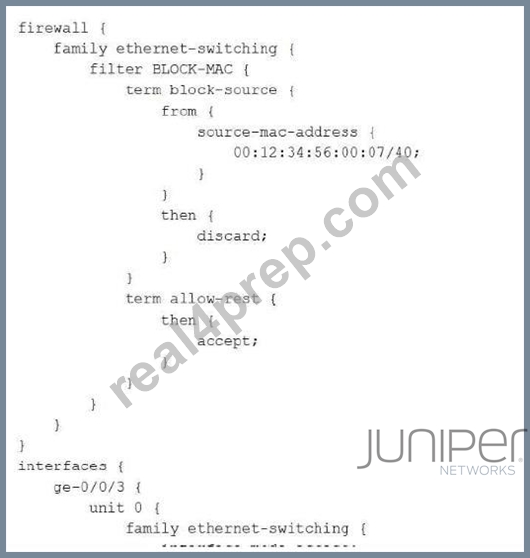
You need to apply a Layer 2 firewall filter on a Juniper Networks EX Series Switch to block traffic from the source MAC address 00:12:34:56:00:07 entering the switch on ge-0/0/3. After committing the configuration, traffic from the MAC address still passes through.
Referring to the exhibit, which statement is correct in this scenario?
- A. Firewall filters under family ethernet-switching cannot match on MAC addresses.
- B. The filter is applied in the wrong direction.
- C. The MAC address and mask in the firewall filter need to be explicit.
- D. The interface needs to be of type trunk for the filter to evaluate correctly.
Answer: C
Explanation:
The intent of this filter is to match and discard traffic from one single, specific host MAC address, which requires the source-mac-address match condition to reference the complete, exact 48-bit address using an explicit /48 mask (or no mask at all, which Junos treats as an implicit full match) so that only that one precise address is matched. As configured, the term instead specifies a /40 mask on 00:12:34:56:00:07, meaning only the first 40 bits (the first five octets, 00:12:34:56:00) are actually significant to the match, while the sixth octet is effectively wildcarded across its full range; this produces an imprecise, overly broad match criterion rather than the single-host match the administrator intended, and is a common configuration mistake that undermines the predictability and correctness of MAC-based filtering. The lesson tested here is that source and destination MAC address match conditions in Junos firewall filters must be specified with the correct, deliberate, and explicit prefix length appropriate to the intended scope - typically /48 for a single exact host
- rather than an arbitrary or miscalculated mask value. Firewall filters under family ethernet-switching are fully capable of matching on both source-mac-address and destination-mac-address, which rules out that option entirely. Layer 2 MAC-based filters function correctly on both access and trunk interface modes, so interface type is not a limiting factor here. There is no indication in the exhibit that the filter's application direction (input versus output) is reversed. Reference topics: Junos Enterprise Switching - Layer 2 Security, MAC Address Match Conditions and Prefix Length Precision.
NEW QUESTION # 47
You have two OSPF routers that will not form an adjacency. You enter the show log trace- ospfcommand.
Referring to the exhibit, which statement is correct?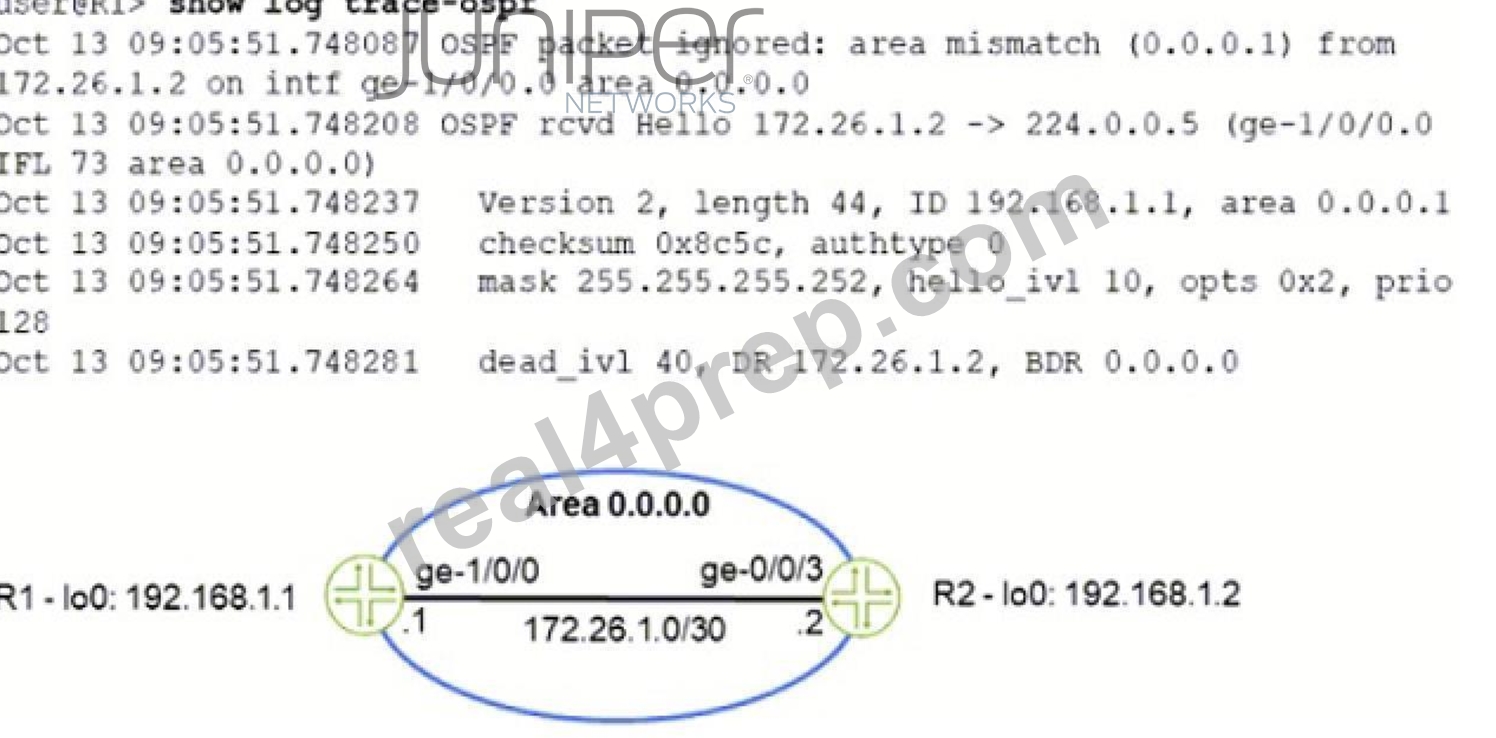
- A. The wrong OSPF area has been configured.
- B. There is a mismatched subnet.
- C. The physical connection has been disconnected.
- D. You are stuck in the ExStart state.
Answer: A
NEW QUESTION # 48
You implemented the MAC address limit feature with the shutdown action on all interfaces on your switch.
In this scenario, which statement is correct when a violation occurs?
- A. By default, devices that are learned before the violation occurs are still allowed to send and receive traffic through the specific interface.
- B. By default, the violation will automatically be cleared after 300 seconds and the interface will resume sending and receiving traffic for all learned devices.
- C. By default, the interface will continue to send and receive traffic for all connected devices after a violation has occurred.
- D. By default, you must manually clear the violation for the interface to send and receive traffic again.
Answer: D
Explanation:
When the MAC address limit feature with the shutdown action is implemented on a switch, if a violation occurs, the interface is disabled and a system log entry is generated. If the switch has been configured with the port-error-disable statement, the disabled interface recovers automatically upon expiration of the specified disable timeout. However, if the switch has not been configured for auto-recovery from port error disabled conditions, you must manually clear the violation by running the clear ethernet-switching port-error command for the interface to send and receive traffic again. This explanation is based on the Enterprise Routing and Switching Specialist (JNCIS-ENT) documents and learning resources available at Juniper Networks.
NEW QUESTION # 49
Which three statements are correct about OSPF packet types? (Choose three.)
- A. Hello packets are sent every 30 seconds by default.
- B. Link-state request packets are sent after receiving an LSA header not in the OSPF database.
- C. Link-state acknowledgment packets are sent every 30 seconds.
- D. Database description packets are used during the adjacency formation process.
- E. Link-state update packets contain one or more LSAs.
Answer: B,D,E
NEW QUESTION # 50
Referring to the exhibit, why is the route for 10.5.5.5 hidden?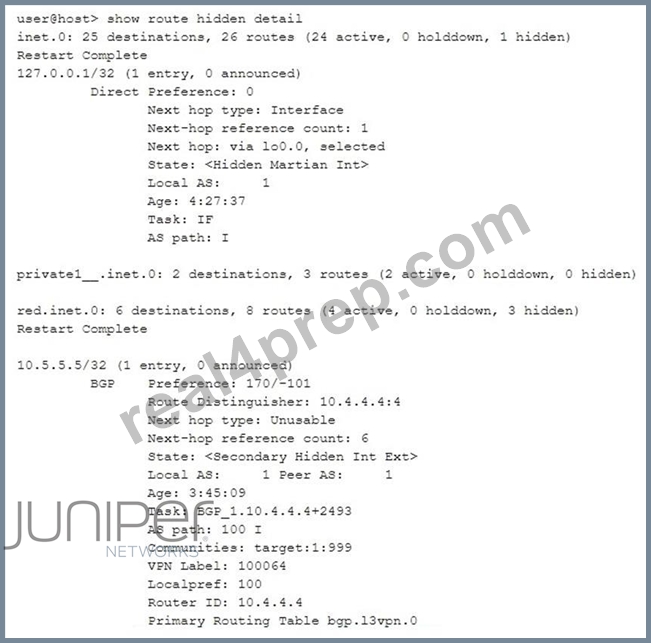
- A. It has an invalid community.
- B. It is an L3VPN route.
- C. It is a martian route.
- D. The next hop cannot be resolved.
Answer: D
NEW QUESTION # 51
Referring to the exhibit, why is this OSPF adjacency remaining in this state?
- A. An MTU mismatch exists between the OSPF neighbors.
- B. A hello interval mismatch exists between the OSPF neighbors.
- C. A subnet mask mismatch exists between the OSPF neighbors.
- D. An area ID mismatch exists between the OSPF neighbors
Answer: A
Explanation:
OSPF stuck in ExStart is mainly related to mismatched MTU. It could also be caused by a firewall filter on the loopback interface, but this is not an alternative.
NEW QUESTION # 52
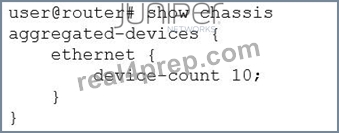
You are attempting to configure the initial two aggregated Ethernet interfaces on a router but there are no aggregated Ethernet interfaces available.
In this scenario, which configuration will enable these interfaces on this router?
- A.
- B.
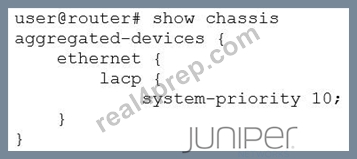
- C.
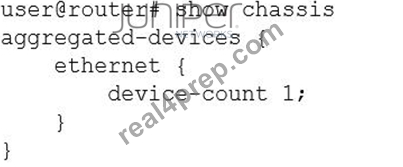
- D.
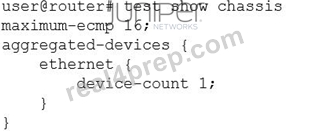
Answer: A
Explanation:
Device count should be more than 1.
NEW QUESTION # 53
You have DHCP snooping enabled but no entries are automatically created in the snooping database for an interface on your EX Series switch. What are two reasons for the problem?
(Choose two.)
- A. The device that is connected to the interface has a static IP address.
- B. The device that is connected to the interface has performed a DHCPRELEASE.
- C. MAC limiting is enabled on the interface.
- D. Dynamic ARP inspection is enabled on the interface.
Answer: A,B
Explanation:
If the device connected to the interface has performed a DHCPRELEASE, it releases its IP address back to the DHCP server, resulting in the removal of the corresponding DHCP snooping entry.
If the device connected to the interface is using a static IP address, it will not send DHCP requests, and therefore no entries will be created in the DHCP snooping database for that device.
NEW QUESTION # 54
Referring to the exhibit, which two statements are correct? (Choose two.)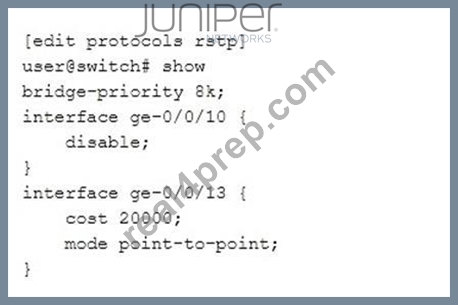
- A. The ge-0/0/10 interface will be part of the RSTP topology but will block incoming BPDUs.
- B. This device must be selected as the root bridge.
- C. The ge-0/0/13 interface will be selected as the forwarding interface.
- D. The ge-0/0/10 interface will not participate in the RSTP topology.
Answer: C,D
NEW QUESTION # 55
......
Dumps of JN0-352 Cover all the requirements of the Real Exam: https://www.real4prep.com/JN0-352-exam.html
New Training Course JN0-352 Tutorial Preparation Guide: https://drive.google.com/open?id=1fR0EG8ZBwur9a-GoWLZSP8sX-JFWh8Dt