


NEW 2026 Certification Sample Questions OGEA-101 Dumps & Practice Exam
OGEA-101 Deluxe Study Guide with Online Test Engine
The Open Group OGEA-101 Exam Syllabus Topics:
| Topic | Details |
|---|---|
| Topic 1 |
|
| Topic 2 |
|
| Topic 3 |
|
| Topic 4 |
|
| Topic 5 |
|
| Topic 6 |
|
| Topic 7 |
|
| Topic 8 |
|
NEW QUESTION # 11
Which of the following describes the practice by which the enterprise architecture is managed and controlled at an enterprise-wide level?
- A. Corporate governance
- B. IT governance
- C. Technology governance
- D. Architecture governance
Answer: D
Explanation:
According to the TOGAF Standard, 10th Edition, architecture governance is "the practice by which enterprise architectures and other architectures are managed and controlled at an enterprise-wide level" 1. Architecture governance ensures that the architecture development and implementation are aligned with the strategic objectives, principles, standards, and requirements of the enterprise, and that they deliver the expected value and outcomes. Architecture governance also involves establishing and maintaining the architecture framework, repository, board, contracts, and compliance reviews 1. The other options are not correct, as they are not the term used by the TOGAF Standard to describe the practice by which the enterprise architecture is managed and controlled at an enterprise-wide level. Corporate governance is "the system by which an organization is directed and controlled" 2, and it covers aspects such as leadership, strategy, performance, accountability, and ethics. IT governance is "the system by which the current and future use of IT is directed and controlled" 2, and it covers aspects such as IT strategy, policies, standards, and services. Technology governance is "the system by which the technology decisions and investments are directed and controlled" 3, and it covers aspects such as technology selection, acquisition, deployment, and maintenance. References: 1:
TOGAF Standard, 10th Edition, Part VI: Architecture Governance, Chapter 44: Introduction. 2: TOGAF Standard, 10th Edition, Part I: Introduction, Chapter 3: Definitions. 3: TOGAF Series Guide: Using the TOGAF Framework to Define and Govern Service-Oriented Architectures, Part II: Using the TOGAF Framework to Define and Govern Service-Oriented Architectures, Chapter 5: Technology Governance.
NEW QUESTION # 12
Full Question:
Consider the image showing basic architectural concepts.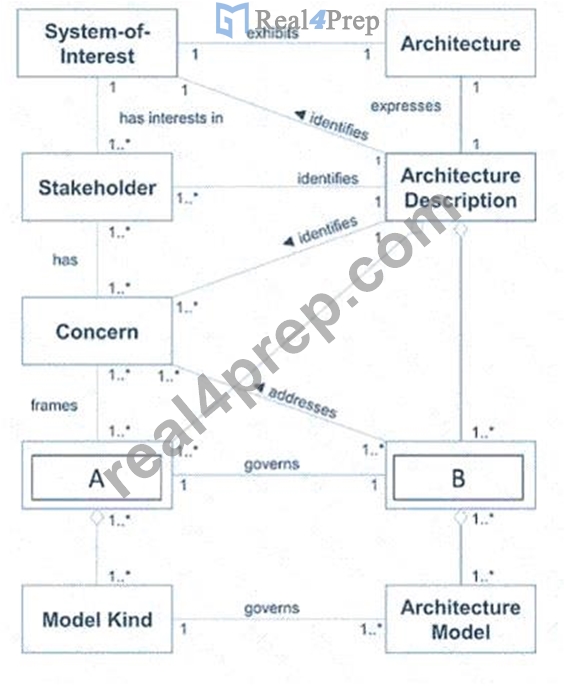
Complete the sentence: Item A ____________, while item B ____________.
- A. is the set of concerns influencing the work product, is a work product influencing a collection of Architecture Views
- B. defines how to construct and use an Architecture View, represents a system from a perspective of a related set of concerns
- C. is an area of interest that stakeholders find important, is the context determining the influences on an Architecture Model
- D. defines how to construct an Architecture View, is a form of abstraction to focus on particular concerns within a system
Answer: B
Explanation:
Item A is an Architecture Viewpoint . In TOGAF, an Architecture Viewpoint defines the conventions for constructing, interpreting, and using an Architecture View. It frames stakeholder concerns and governs the related views and model kinds used to express the architecture.
Item B is an Architecture View . An Architecture View represents a system from the perspective of a related set of concerns. It is created according to an Architecture Viewpoint and is used to communicate architecture information to specific stakeholders.
The diagram shows that concerns are framed by item A, and item A governs item B. It also shows that item B is connected to Architecture Models, which supports the interpretation that B is the Architecture View. This matches the standard TOGAF concept structure: stakeholders have concerns, concerns are framed by viewpoints, viewpoints govern views, and views are made up of architecture models.
Therefore, item A is the Architecture Viewpoint, and item B is the Architecture View. The correct answer is B
.
NEW QUESTION # 13
Consider the following statement.
According to the TOGAF standard, a governed approach of a particular deliverable will ensure adherence to the principles, standards, and requirements of the existing or developing architectures.
Which deliverable does this refer to?
- A. The Architecture Definition Document
- B. The Architecture Vision
- C. An Architecture Contract
- D. The Statement of Architecture Work
Answer: C
Explanation:
According to the TOGAF Standard, 10th Edition, an architecture contract is "a formal agreement between a service provider and a service consumer that defines the mutual commitments and expectations for the delivery of an architecture" 1. An architecture contract is a governed approach of a particular deliverable that will ensure adherence to the principles, standards, and requirements of the existing or developing architectures, as it specifies the roles, responsibilities, deliverables, quality criteria, and acceptance criteria for the architecture work 1. The other options are not correct, as they are not governed approaches of a particular deliverable, but rather different types of deliverables withinthe architecture development process. An architecture vision is "a high-level, aspirational view of the target architecture" 1. A statement of architecture work is "a document that defines the scope and approach that will be used to complete an architecture project"
1. An architecture definition document is "a document that describes the baseline and target architectures for one or more domains" 1. References: 1: TOGAF Standard, 10th Edition, Part I: Introduction, Chapter 3:
Definitions.
NEW QUESTION # 14
Consider the following statements:
1. Each contracted party is required to act responsibly to the organization and its stakeholders.
2. All decisions taken, processes used, and their implementation will not be allowed to create unfair advantage to any one particular party.
3. Digital Transformation and operations will be more effective and efficient.
4. Strategic decision-making by C-Level executives and business leaders will be more effective.
Which statements highlight the value and necessity for Architecture Governance to be adopted within organizations?
- A. 2 & 3
- B. 1 & 2
- C. 3 & 4
- D. 1 & 4
Answer: B
Explanation:
Architecture governance is the practice of ensuring compliance with the enterprise architecture and its principles, standards, and goals. Architecture governance provides the means to establish, monitor, and control the architecture development and implementation processes, and to resolve any issues or conflicts that may arise. Architecture governance also ensures that all stakeholders are represented and involved in the decision-making process, and that their interests and concerns are balanced and aligned. Statements 1 and 2 highlight the value and necessity for architecture governance to be adopted within organizations, as they emphasize the importance of responsibility, accountability, fairness, and transparency in the architectural activities. Statements 3 and 4 are more related to the benefits and outcomes of having a good enterprise architecture, rather than the governance aspect.
NEW QUESTION # 15
What is an objective of the ADM Preliminary Phase?
- A. To create the initial version of the Architecture Roadmap
- B. To select and implement tools to support the Architecture Capability
- C. To develop a vision of the business value to be delivered by the proposed enterprise architecture
- D. To obtain approval for the Statement of Architecture Work
Answer: B
Explanation:
The Preliminary Phase is the preparatory phase of the Architecture Development Method (ADM) cycle, which sets the context and direction for the architecture work. One of the objectives of this phase is to select and implement tools to support the Architecture Capability, which is the ability of an organization to perform enterprise architecture effectively and efficiently. Tools can include software applications, methods, techniques, standards, and frameworks that assist the architecture development and governance processes. The selection and implementation of tools should be based on the requirements and constraints of the organization, and the alignment with the Architecture Principles and the Architecture Vision3 Reference: 3: The TOGAF Standard, Version 9.2, Part II: Architecture Development Method (ADM), Chapter 6: Preliminary Phase : The TOGAF Standard, Version 9.2, Part VI: Architecture Capability Framework, Chapter 45: Establishing and Maintaining an Enterprise Architecture Capability : The TOGAF Standard, Version 9.2, Part VI: Architecture Capability Framework, Chapter 46: Tools for Architecture Development
NEW QUESTION # 16
Which section of the TOGAF template for Architecture Principles should describe the relationship to other principles?
- A. Statement
- B. Implications
- C. Rationale
- D. Name
Answer: C
Explanation:
According to the TOGAF template for Architecture Principles, the Rationale section should describe the relationship to other principles, as well as the business benefits and the intentions of adhering to the principle. The Rationale section should use business terminology and point to the similarity of information and technology principles to the principles governing business operations. The Rationale section should also explain how the principle supports the achievement of the business objectives and key architecture drivers. Reference:
* Architecture Principles Template
* The TOGAF Standard, Version 9.2 - Architecture Principles
* The Open Group Exam OGEA-103 Topic 1 Question 4 Discussion
NEW QUESTION # 17
Which one of the following classes of information within the Architecture Repository would typically contain a list of the applications in use within the enterprise?
- A. Architecture Landscape
- B. Governance Log
- C. Architecture Metamodel
- D. Reference Library
Answer: A
Explanation:
The Architecture Landscape is a class of information within the Architecture Repository that shows an architectural view of the building blocks that are in use within the organization today (the Baseline Architecture), as well as those that are planned for the future (the Target Architecture). The Architecture Landscape typically contains a list of the applications in use within the enterprise, along with their relationships and dependencies, as well as other relevant architectural information. The Architecture Landscape helps to identify opportunities for re-use, consolidation, or retirement of existing applications, as well as gaps or overlaps in the current or future architecture.
NEW QUESTION # 18
Which one of the following classes of information within the Architecture Repository would typically contain a list of the applications in use within the enterprise?
- A. Architecture Landscape
- B. Governance Log
- C. Architecture Metamodel
- D. Reference Library
Answer: A
Explanation:
The Architecture Landscape is a class of information within the Architecture Repository that shows an architectural view of the building blocks that are in use within the organization today (the Baseline Architecture), as well as those that are planned for the future (the Target Architecture). The Architecture Landscape typically contains a list of the applications in use within the enterprise, along with their relationships and dependencies, as well as other relevant architectural information. The Architecture Landscape helps to identify opportunities for re-use, consolidation, or retirement of existing applications, as well as gaps or overlaps in the current or future architecture.Reference: : The TOGAF Standard, Version 9.2, Part IV: Architecture Content Framework, Chapter 34: Architecture Landscape : The TOGAF Standard, Version 9.2, Part VI: Architecture Capability Framework, Chapter 47: Architecture Repository
NEW QUESTION # 19
Which of the following best describes the need for the ADM process to be governed?
- A. To enable development of reference architectures
- B. To enable a fast response to market changes
- C. To permit the architecture domains to be integrated
- D. To verify that the method is being applied correctly
Answer: D
Explanation:
According to the TOGAF standard, the need for the ADM process to be governed is to ensure that the architecture development and implementation activities are conducted in a consistent, coherent, and compliant manner1. Governance provides the means to verify that the method is being applied correctly and effectively, and that the architecture deliverables and artifacts meet the quality and standards criteria1. Governance also enables the management of risks, issues, changes, and dependencies that may arise during the ADM process1.
Some of the benefits of governing the ADM process are2:
*Improved alignment of the architecture with the business strategy and objectives
*Enhanced stakeholder engagement and communication
*Increased reuse and integration of architecture assets and resources
*Reduced complexity and duplication of architecture efforts
*Increased agility and adaptability of the architecture to changing needs and requirements
*Improved compliance and auditability of the architecture outcomes and outputs References: 1: Architecture Governance 2: Architecture Governance Benefits
NEW QUESTION # 20
Consider the following ADM phases objectives.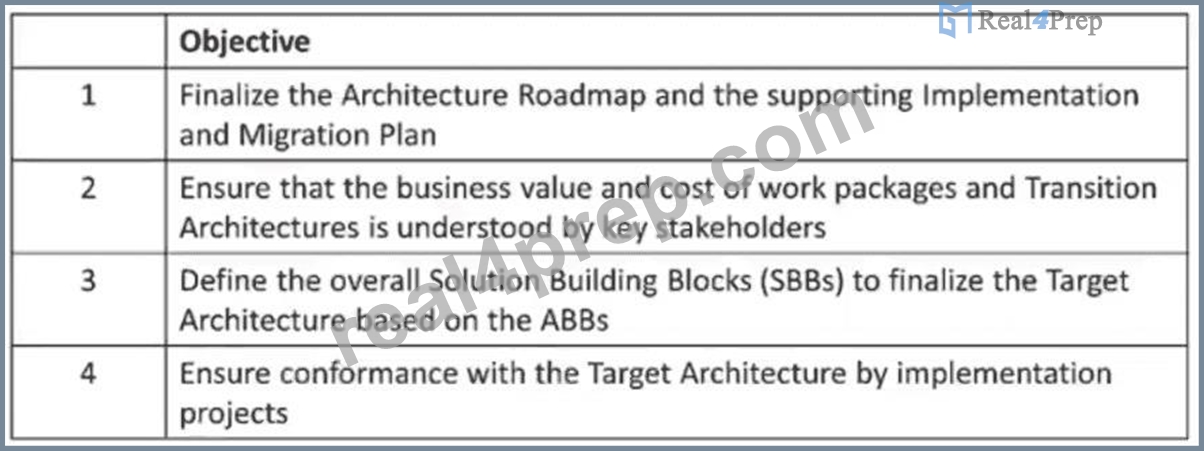
Which phase does each objective match?
- A. 1F-2F-3E-4G
- B. 1F-2G-3F-4F
- C. 1G-2E-3F-4E
- D. 1E-2F-3E-4G
Answer: D
Explanation:
1E: To identify delivery vehicles (projects programs portfolios) that will deliver the Target Architecture 2F:
To confirm readiness and ability to undergo change 3E: To determine whether an incremental approach is required and if so identify Transition Architectures that will deliver continuous business value 4G: To perform appropriate governance functions while the solution is being implemented Reference: The TOGAF Standard | The Open Group Website, Section 3.2 ADM Phases.
NEW QUESTION # 21
What is present in all phases within the ADM and should be identified, classified and mitigated before starting a transformation effort?
- A. Schedule constraints
- B. Budgetary constraints
- C. Risk
- D. Information gaps
Answer: C
Explanation:
According to the TOGAF Standard, 10th Edition, risk is present in all phases within the Architecture Development Method (ADM), and it should be identified, classified, and mitigated before starting a transformation effort 1. Risk is defined as "the effect of uncertainty on objectives" 2, and it can have positive or negative impacts on the architecture project. Risk management is a technique that helps to assess and address the potential risks that may affect the achievement of the architecture objectives, and to balance the trade-offs between opportunities and threats. Risk management is applied throughout the ADM cycle, from the Preliminary Phase to the Requirements Management Phase, and it is integrated with other techniques, such as stakeholder management, business transformation readiness assessment, gap analysis, and migration planning 1. The other options are not correct, as they are not present in all phases within the ADM, and they are not necessarily identified, classified, and mitigated before starting a transformation effort. Budgetary constraints are the limitations on the financial resources available for the architecture project, and they are usually considered in Phase E: Opportunities and Solutions, and Phase F: Migration Planning 3. Schedule constraints are the limitations on the time available for the architecture project, and they are also usually considered in Phase E and F 3. Information gaps are the missing or incomplete data or knowledge that may affect the architecture project, and they are usually identified in Phase B: Business Architecture, Phase C: Information Systems Architecture, and Phase D: Technology Architecture . Reference: 1: TOGAF Standard, 10th Edition, Part III: ADM Guidelines and Techniques, Chapter 32: Risk Management. 2: TOGAF Standard, 10th Edition, Part I: Introduction, Chapter 3: Definitions. 3: TOGAF Standard, 10th Edition, Part II: Architecture Development Method, Chapter 16: Phase E: Opportunities and Solutions, and Chapter 17: Phase F: Migration Planning. : TOGAF Standard, 10th Edition, Part II: Architecture Development Method, Chapter 13: Phase B: Business Architecture, Chapter 14: Phase C: Information Systems Architecture, and Chapter 15: Phase D: Technology Architecture.
NEW QUESTION # 22
Consider the following statements
1 A whole corporation or a division of a corporation
2 A government agency or a single government department
3 Partnerships and alliances of businesses working together such as a consortium or supply chain What are those examples of according to the TOGAF Standard?
- A. Business Units
- B. Architectures Scopes
- C. Enterprises
- D. Organizations
Answer: C
Explanation:
Enterprises are examples of the scope of an architecture according to the TOGAF Standard. An enterprise is defined as any collection of organizations that has a common set of goals and/or a single bottom line.
Enterprises can be whole corporations or divisions of a corporation, government agencies or single government departments, partnerships and alliances of businesses working together, etc. Reference: The TOGAF Standard | The Open Group Website, Section 2.1 Core Concepts.
NEW QUESTION # 23
Which ADM phase focuses on defining the problem to be solved, identifying the stakeholders, their concerns, and requirements?
- A. Phase
- B. Preliminary Phase
- C. Phase
- D. Phase A
Answer: D
Explanation:
Phase A: Architecture Vision is the first phase of the Architecture Development Method (ADM) cycle, which is the core of the TOGAF standard. The main purpose of this phase is to define the scope and approach of the architecture development, and to create the Architecture Vision, which is a high-level description of the desired outcomes and benefits of the proposed architecture. To achieve this purpose, this phase focuses on defining the problem to be solved, identifying the stakeholders, their concerns, and requirements, and establishing the business goals and drivers that motivate the architecture work. This phase also involves obtaining the approval and commitment of the sponsors and other key stakeholders, and initiating the Architecture Governance process.
The TOGAF Standard, Version 9.2, Part II: Architecture Development Method (ADM), Chapter 5:
Introduction to the ADM : The TOGAF Standard, Version 9.2, Part II: Architecture Development Method (ADM), Chapter 18: Phase A: Architecture Vision : The TOGAF Standard, Version 9.2, Part II: Architecture Development Method (ADM), Chapter 18.3: Inputs : The TOGAF Standard, Version 9.2, Part II: Architecture Development Method (ADM), Chapter 18.4: Steps
NEW QUESTION # 24
What is the purpose of the Preliminary Phase?
- A. Defining the Enterprise Strategy.
- B. Developing an Enterprise Architecture Capability.
- C. Describing the target architecture.
- D. Identifying the stakeholders and their requirements.
Answer: B
Explanation:
An Enterprise Architecture Capability is the ability of the organization to perform effective and efficient architecture work, including the definition, governance, and management of its architectures2. The Preliminary Phase involves the following activities1:
* Reviewing the organizational context, scope, and drivers for conducting Enterprise Architecture
* Establishing the Architecture Capability desired by the organization, including the maturity level, roles, responsibilities, processes, and tools
* Defining and establishing the Organizational Model for Enterprise Architecture, which describes how the architecture function is organized and integrated within the enterprise
* Defining and establishing the Architecture Governance framework, which provides the mechanisms for ensuring the quality, consistency, and compliance of the architecture work
* Selecting and implementing the tools that support the Architecture Capability, such as repositories, modeling tools, and communication tools
* Defining the Architecture Principles that will guide and constrain the architecture work, based on the business principles, goals, and drivers of the organization
* Defining the Organization-Specific Architecture Framework, which is an adaptation of the generic TOGAF ADM to suit the specific requirements, standards, and practices of the organization The Preliminary Phase is essential for preparing the organization for the successful development and implementation of its architectures, as well as for ensuring the alignment of the architecture work with the business strategy and objectives1.
NEW QUESTION # 25
Consider the illustration.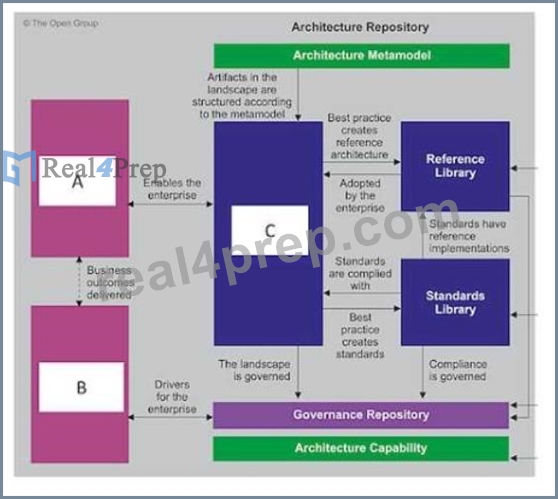
What are the items labelled A B and C?
- A. A-Architecture Landscape B-Architecture Requirements Repository C-Solutions Landscape
- B. A-Solution Landscape, B-Architecture Requirements Repository. C-Architecture Landscape
- C. A-EA Landscape, B-Requirements Repository. C-Artifacts Landscape
- D. A-Architecture Requirements Repository, B-Solutions Repository, C-Architecture Landscape
Answer: D
Explanation:
This aligns with the TOGAF Architecture Repository model where:
* A (Architecture Requirements Repository)contains requirements that drive architecture work.
* B (Solutions Repository)stores the building blocks or solutions that support the architecture.
* C (Architecture Landscape)represents the architecture assets that depict the current, transition, and target architecture states across the enterprise
NEW QUESTION # 26
......
OGEA-101 dumps review - Professional Quiz Study Materials: https://www.real4prep.com/OGEA-101-exam.html
OGEA-101 Test Prep Training Practice Exam Questions Practice Tests: https://drive.google.com/open?id=1sSCvfk__vJjxkEEmV1GhF2WvYje2pu1G