


CTFL-AcT PDF Download Dec-2025 ISQI Test To Gain Brilliante Result!
Provide Updated ISQI CTFL-AcT Dumps as Practice Test and PDF
The CTFL-AcT certification exam is ideal for software testers, quality assurance professionals, and software developers who are involved in software acceptance testing. ISTQB Foundation Level - Acceptance Testing certification is recognized globally and is highly valued in the software industry. It is an excellent way for professionals to demonstrate their skills and knowledge, improve their career prospects, and gain recognition for their expertise.
NEW QUESTION # 23
Which one of the following statements regarding acceptance criteria is true?
- A. For each requirement of user story, the acceptance criteria refine and specify how to test it
- B. For each requirement or user story, the acceptance criteria refine and specify what is expected
- C. Acceptance criteria are used to measure code coverage of the test object
- D. Acceptance criteria relate generally to some business goals and sometimes to some business needs
Answer: B
Explanation:
Acceptance criteria define the conditions under which a user story or requirement is considered complete and acceptable to stakeholders. They clarify the expected behavior, outcomes, or attributes of the system.
Option C is correct because it accurately reflects that acceptance criteria are used to specify what is expected from the system in relation to a given requirement or user story. This ensures a shared understanding among developers, testers, and business stakeholders.
Other options:
A is vague and misleading - acceptance criteria relate directly to specific stories or features, not generally to high-level goals.
B is partially correct but limited - while acceptance criteria help define test conditions, their purpose is broader than just test specification.
D is incorrect - acceptance criteria are not related to code coverage, which is a technical test metric.
C). For each requirement or user story, the acceptance criteria refine and specify what is expected
NEW QUESTION # 24
As a tester you are part of a development team for health monitoring system to record and synchronize various health parameters, calculate health score and provide practical advice on how to maintain and improve health. You are asked to review the acceptance criteria for the following user story:
US23; As a user of the system. I can monitor my blood pressure and obtain alerts in case of excessive pressure, in order to prevent the risk associated with hypertension.
Which of the following is NOT a good example of an acceptance criterion for this requirement?
- A. The alert thresholds depend on the following user's personal settings: age, weight and gender
- B. The monitoring system displays the heart rate together with the blood pressure
- C. The system should be developed using Java script framework to allow fast response times
- D. People with hypertension are advised to get their blood pressure checked at least thrice a week
Answer: C
Explanation:
Acceptance criteria describe what the system must do to fulfill a requirement from the user or business perspective. They must be observable, testable, and relevant to the business outcome or expected behavior.
In this scenario, the user story is about monitoring blood pressure and receiving alerts for excessive pressure.
The acceptance criteria should focus on system behavior, thresholds, and how alerts are triggered based on user settings.
Option D is not a good acceptance criterion because:
It specifies a technical implementation detail (JavaScript framework), which is not the concern of acceptance testing.
Acceptance criteria should not prescribe how the system is built, but what it must do from a business or user point of view.
Other options (A, B, and C) all reflect testable and behavior-focused outcomes linked to the user story's goal.
D). The system should be developed using JavaScript framework to allow fast response times
NEW QUESTION # 25
Which TWO of the following statements about exploratory testing are most true?
- A. Exploratory testing is and experience-based test technique which refines acceptance criteria into acceptance test cases
- B. Exploratory testing implements time-boxed sessions to prioritize tests bases on product risk analysis
- C. Exploratory testing is achieved by combining product discovery, test design and execution, and results L- interpretation
- D. Exploratory testing is rather carried out by people with a good knowledge of the business domain, bot not necessarily of the tested functionality
- E. Exploratory testing generally begins with the definition of the test charter that defines the detailed test L-' conditions
Answer: C,E
Explanation:
Exploratory testing is a dynamic testing technique where learning, test design, execution, and interpretation occur simultaneously. It is especially useful when detailed requirements are unavailable or when testers rely on experience and intuition.
A is correct: Exploratory testing combines exploration, learning about the product, designing and executing tests on the fly, and interpreting the results - all within the same session.
E is also correct: Exploratory testing usually starts with a high-level test charter that defines the mission, objectives, or focus area for the session. It may not define specific test conditions, but it outlines the scope and intent.
Other options:
B: Not accurate - while timeboxing is used, exploratory testing typically relies on charters and experience rather than detailed product risk analysis to prioritize.
C: Incorrect - exploratory testing is not about refining acceptance criteria; that's part of ATDD.
D: Partially true but misleading - good business domain knowledge helps, but understanding the functionality is also important in exploratory testing.
NEW QUESTION # 26
Which of the following reasons explains BEST why it makes sense to review test reports?
- A. If the test reports are unclear or incomplete, the decision to release the product can be base on non reliable information
- B. Test automation engineers may misunderstand the test case and implement test scripts that miss the target
- C. Like all humans, the tester can make mistakes and overlook important acceptance criteria of a requirement / user story
- D. The test report quality significantly influences the impression third parties get from the organization / the product.
Answer: A
Explanation:
Test reports summarize the results of test execution and are often used by stakeholders, including business owners and release managers, to make informed decisions about whether to release a product. If these reports are ambiguous, incomplete, or inaccurate, the decisions based on them could be flawed, leading to reputational damage, customer dissatisfaction, or regulatory issues.
Option A is correct because it highlights the risk of basing critical go/no-go decisions on poor-quality reporting.
Other options:
B describes a problem with test case implementation, not test reporting.
C mentions public perception, which might be influenced by report quality, but it is secondary to the internal decision-making purpose.
D refers to human error during test execution or design, not the purpose of reviewing test reports.
A). If the test reports are unclear or incomplete, the decision to release the product can be based on non-reliable information
NEW QUESTION # 27
Which of the following provides the BEST description of Beta testing?
- A. In Agile, beta testing must be performed at the same time as user stories are developed
- B. Beta testing aims to obtain feedback from users in their context of use
- C. Beta testing is generally performed jointly by testers, business analysts, product owners and developers
- D. The effectiveness of beta testing sessions depends on the quality of the test charter
Answer: B
Explanation:
Beta testing is a form of external user acceptance testing where real users test the product in their environment before the official release. It helps identify issues that may not have been caught in internal testing and gather user feedback on functionality, usability, and performance in real-world conditions.
Option C is correct - the core goal of beta testing is to obtain user feedback in their actual usage context, providing insight into how the system performs outside of controlled environments.
Other options:
A: Test charters are used in exploratory testing, not typically in beta testing.
B: Incorrect - beta testing is not tied to the timing of user story development in Agile.
D: Incorrect - beta testing is performed by end users, not by internal team members like developers or business analysts.
C). Beta testing aims to obtain feedback from users in their context of use
NEW QUESTION # 28
Which one of the following scenarios characterizes UX task analysis BEST?
- A. Users are qualified depending on their physical and intellectual characteristics.
- B. Inspirations from similar sectors are sought to identify successful solutions.
- C. External conditions are considered as input for subsequent design steps.
- D. Use cases are analyzed and represented through business process models.
Answer: C
Explanation:
UX task analysis focuses on understanding how users perform their tasks in real-world contexts. It captures not only the sequence of actions but also the surrounding environment - including physical conditions (light, noise), devices used, interruptions, and constraints. These external or environmental conditions become vital inputs to UX design decisions, helping teams adapt interfaces and workflows to user realities.
Option C is correct because it emphasizes this key aspect of UX task analysis: capturing external conditions that influence usability and system interaction.
Other options:
A focuses on user profiling, not task analysis.
B refers to business process modeling, which is more strategic and less user-context specific.
D refers to benchmarking or inspiration analysis - useful for design ideation but not task analysis.
C). External conditions are considered as input for subsequent design steps.
NEW QUESTION # 29
As an acceptance tester you are analyzing the following user story for a computer web-based mass multiplayer role-playing game:
As an unregistered player
I want to be able to register myself by defining my e-mail, login and password in a registration form so that I become a registered player Consider the following propositions of the acceptance criteria:
i.a registration form is displayed on the screen.
ii.the form is written in the Groovy language; the cursor is initially set on the 'login' field; after pushing the TAB button the cursor switches to 'password', 'repeat password', 'mail', and 'repeat mail' forms.
iii.I cannot register myself if the login I choose is used by another player.
iv.after successful registration process I am informed about it by an e-mail.
Which of the above statements would you consider as well-written acceptance criteria?
- A. only i), iii) and iv)
- B. only ii)
- C. only i) and iii)
- D. only ii) and iv)
Answer: A
NEW QUESTION # 30
Which one of the following test design techniques fits accepting testing purposes BEST?
- A. static code analysis
- B. equivalence partitioning
- C. defect-based test design
- D. input validation
Answer: B
NEW QUESTION # 31
For a project to migrate an employee qualification management system to web technologies, the following requirement has been defined REQ 3-12 The system must be able to manage 3 types of users: HR team member with full rights, department manager with consultation and update rights only for members of his/her department, and employee with read-only access to his/her data Which of the following sentences BEST reflects an acceptable acceptance criterion?
- A. Security test must be performed to demonstrate that the authentication and rights management system is working properly
- B. The database must use MangoDB
- C. Since I am logged in as a department manager, when I try to access the file of an employee who is not in my department then a message telling me that I do not have access rights is displayed
- D. The list of employees who are members of a department can only be updated by a person logged as HR
Answer: C
Explanation:
Acceptance criteria should define how the system behaves for a given user story or requirement. They must be precise, testable, and directly traceable to the requirement being verified.
REQ 3-12 describes access control for three user types. Option B is a concrete, scenario-based acceptance criterion that tests the enforcement of access rights - making it an ideal match.
Other options:
A is irrelevant - database technology (MongoDB) is an implementation detail, not a functional criterion.
C is too vague - stating that security tests must be performed doesn't specify expected behavior or outcome.
D is plausible, but option B more directly demonstrates how an actual system behavior validates the requirement.
B). Since I am logged in as a department manager, when I try to access the file of an employee who is not in my department then a message telling me that I do not have access rights is displayed
NEW QUESTION # 32
Which one of the following answers lists characteristic of quality in use according to the quality in use model defined in ISO 25010?
- A. User experience
- B. Freedom of interference
- C. Satisfaction
- D. Security
Answer: C
Explanation:
According to ISO/IEC 25010:2011, the "Quality in Use" model includes characteristics that measure the system's impact on stakeholders during actual usage in a specific context.
The four main characteristics of Quality in Use are:
Effectiveness
Efficiency
Satisfaction
Freedom from Risk
Option C is correct because "Satisfaction" is one of the core quality-in-use characteristics and refers to the degree to which user needs are fulfilled in context.
Other options:
A (User experience) is a broader term not formally defined as a Quality in Use characteristic in ISO 25010.
B (Security) is part of the product quality model, not quality in use.
D (Freedom of interference) is not a defined term in ISO 25010; it may be a misstatement of "freedom from risk."
NEW QUESTION # 33
As an acceptance tester you want to test the $100 withdrawal process described by the following Business Process Model and Notation (BPMN) model.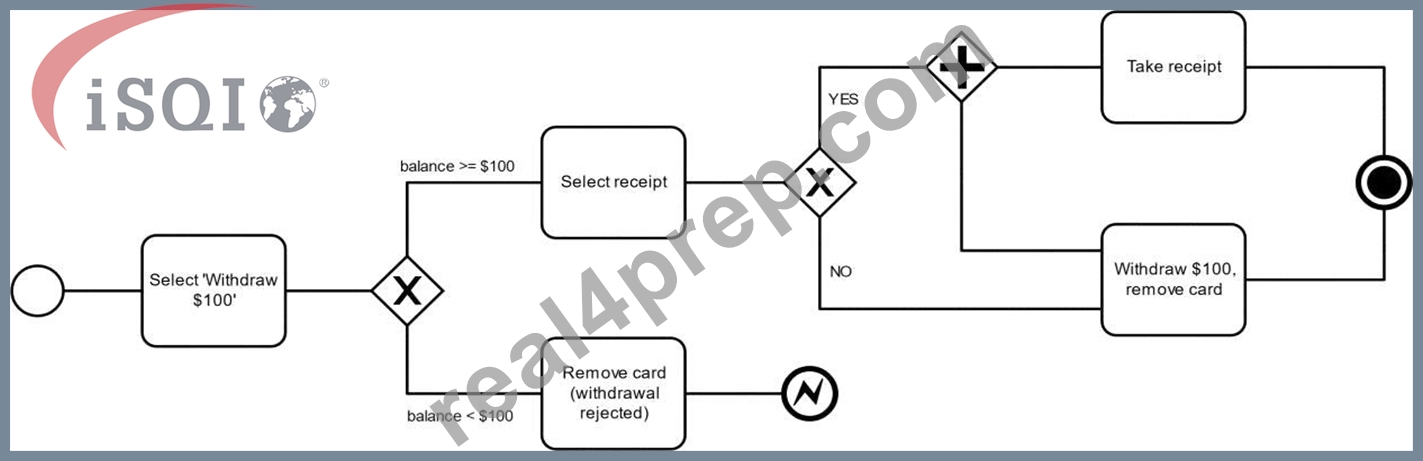
You would like to achieve the following coverage criterion "execute all possible process tasks". Consider the following test cases:
Test 1: balance = $100, receipt = YES
Test 2: balance = $120, receipt = NO
Test 3: balance = $85
Test 4: balance = $20, receipt = YES
Which of the following is the minimal set of test cases allowing to achieve required coverage?
- A. Test 1, Test 2, Test 3
- B. Test 2, Test 4
- C. Test 1, Test 2, Test 4
- D. Test 1, Test 3
Answer: D
NEW QUESTION # 34
Which one of the following statements regarding the quality of requirements is MOST correct?
- A. Vague or ambiguous requirements may lead to misunderstandings both during implementation and testing.
- B. Testers may complete unclear requirements by assumptions, as long as they discuss those assumptions with at least one stakeholder.
- C. INVEST is a technique that ensure the quality of user stories or requirements, thus replacing regular reviews.
- D. In Agile development lifecycle models, requirement engineering becomes less important due to the product owner role.
Answer: A
NEW QUESTION # 35
Which of the following statements regarding test execution and defect analysis is MOST correct?
- A. Testers compare the actual execution outcome to acceptance criteria and report deviations, if observed
- B. The document defects are assigned to a developer so that he or she can fix it for the next version
- C. Business analysts repeat failed acceptance test to assess the impact if the observed behavior
- D. Business analysts and testers explore the business process model to execute the acceptance test
Answer: A
Explanation:
In acceptance testing, testers execute test cases that are directly derived from user stories or requirements via their acceptance criteria. During execution, testers compare the actual outcome of the system with the expected result described in the acceptance criteria. If there's a mismatch (a deviation), it is documented as a defect or discrepancy.
This process is essential for validating that the system meets business needs. The tester's role includes reporting clear, objective findings-not fixing the defect or deciding its severity (which might involve developers or business analysts).
Option A is incorrect: Business analysts may support testing, but execution is primarily a tester's responsibility.
Option C is not fully correct: While developers may fix defects, assignment and triage follow a formal workflow and do not happen automatically.
Option D is incorrect: Business analysts don't repeat test executions; this is the tester's responsibility.
NEW QUESTION # 36
Which of the following information is most likely part of an acceptance test summary report?
- A. Technical details on defect fixes.
- B. Information to evaluate the level of risk for product release.
- C. Test procedure information.
- D. Test strategy and test design methods.
Answer: B
NEW QUESTION # 37
Which one of the following test design techniques fits accepting testing purposes BEST?
- A. static code analysis
- B. equivalence partitioning
- C. defect-based test design
- D. input validation
Answer: B
Explanation:
Equivalence Partitioning (EP) is a black-box test design technique that divides input data into valid and invalid partitions, where each partition is expected to exhibit similar behavior. In the context of acceptance testing, EP is especially effective because it helps validate whether a system behaves correctly for representative input ranges defined in the acceptance criteria.
Acceptance testing aims to confirm that the system meets business requirements and handles inputs as expected. EP allows the tester to cover a large input space using fewer test cases while maintaining a high level of effectiveness. It supports efficiency, broad coverage, and relevance to user expectations.
Other options are less suitable:
A). Static code analysis is a white-box technique, more relevant to unit or integration testing.
B). Input validation is an objective or activity, not a test design technique.
D). Defect-based testing is more diagnostic, used after failures or during exploratory testing - less structured for planned acceptance testing.
Exact Reference - ISTQB CTFL Acceptance Testing Syllabus (Section 2.4):
"Black-box techniques such as equivalence partitioning and boundary value analysis are suitable for deriving acceptance tests from user stories or business rules."
NEW QUESTION # 38
Which of the following sentences explains BEST how acceptance test cases can be derived from the acceptance criteria
- A. Risk-based testing is not a good practice for designing and prioritizing tests because the objective is to cover only the acceptance criteria
- B. Acceptance criteria are not useful for creating acceptance test cases because experience-based techniques should be preferred
- C. Test techniques such as business process-based testing or use case testing can be used to create acceptance tests from the acceptance criteria
- D. Test design should start with non-functional acceptance criteria and only then with functional aspects
Answer: C
Explanation:
Acceptance criteria describe the conditions under which a requirement or user story is considered fulfilled.
These criteria serve as the basis for deriving acceptance test cases. To transform them into concrete tests, testers apply test design techniques such as:
Business process-based testing (deriving tests from modeled workflows)
Use case testing (based on user interactions with the system)
Option B is correct because it clearly describes how structured techniques are applied to translate acceptance criteria into actionable test cases, ensuring traceability and relevance.
Other options:
A is incorrect - experience-based techniques may supplement, but structured methods are foundational in deriving test cases from defined criteria.
C is misleading - risk-based testing is a well-established and effective practice for prioritizing test efforts, including acceptance testing.
D is incorrect - both functional and non-functional criteria are important; there's no fixed rule to prioritize one over the other.
B). Test techniques such as business process-based testing or use case testing can be used to create acceptance tests from the acceptance criteria
NEW QUESTION # 39
As a tester you participate in the project of the decision support system for granting a loan. You are asked to review the acceptance criteria for the following requirement:
REQ 3.28. The automated system records critical credit application data (CCAD. needed to support application screening.
Assume that it is well known what kind of data CCAD are. Which of the following would be the BEST example of an acceptance criterion for this requirement?
- A. The CCAD are stored in the MySQL relational database after each successful data entry procedure.
- B. The CCAD is not recorded if it is incomplete and a message is displayed.
- C. The process for collecting CCAD meets corporate usability guidelines.
- D. The CCAD record process is quick and reversible.
Answer: A
Explanation:
Acceptance criteria must be concrete, testable, and focused on observable system behavior. They define what the system must do to satisfy a requirement and help determine whether the requirement has been successfully implemented.
REQ 3.28 states: "The automated system records critical credit application data (CCAD) needed to support application screening." From this, we infer that the system must persistently store this data after data entry.
Option A is the best match because it provides a specific, observable behavior (CCAD being stored in a MySQL database after a successful entry) that can be verified through acceptance testing. It's a measurable outcome, aligned with the requirement's objective.
Other options are less suitable:
Option B introduces new behavior (displaying a message) not directly tied to the original requirement.
Option C is vague ("quick and reversible") and lacks measurable criteria.
Option D refers to usability guidelines, which is not directly relevant to the storage functionality stated in the requirement.
Exact Reference - ISTQB CTFL Acceptance Testing Syllabus (Section 1.3.2):
"Well-written acceptance criteria are unambiguous, testable, and focused on observable results."
NEW QUESTION # 40
Which tool fits the mentioned acceptance test activities BEST?
- A. Test management and automation tools for business process model-based acceptance test generation.
- B. Model-based testing tools for managing incidents.
- C. Requirements management tools for managing acceptance test execution campaigns.
- D. Business process management tools for modeling business processes and rules.
Answer: D
NEW QUESTION # 41
The project team is currently facing a difficult situation originating from their difficulty in envisioning the future and the necessary steps to reach it together with a certain loss of motivation due to a strong feeling of stagnation. You try to unlock the situation by proposing a workshop. Which one would fit the best?
- A. You ask two volunteers to play a part in front of the team. One will try to defend the project and propose positive arguments and ways forward. The other will do the opposite. You then recapitulate the major arguments of both sides and debate them openly with the team.
- B. You visualize all remaining major milestones of the project, starting with today and ending with project release. Then, you ask the team to identify and discuss the necessary actions to move forward from the present situation and to reach the milestones.
- C. You organize a day out with challenging physical exercises practiced in teams followed by an afterwork dinner and drink. After all, nothing is best for motivation than hard times together, strong common objectives and a promise of good time.
- D. You draw a staircase with 11 steps, each of them representing a major milestone of the project. The bottom of the stairs corresponds to the first day of the project and the upper step means that the project is released. You locate the present situation in the middle of the stairs. The team is asked to identify and discuss the major steps down and up.
Answer: D
Explanation:
In situations where a team is demotivated or struggling with vision and direction, it's effective to use visualization workshops that help the team reflect on progress and visualize a path forward.
Option B describes a metaphorical workshop using a staircase to represent the project's journey - this is known as the "Stairway Retrospective" or "Timeline Workshop". It provides a shared mental model, identifies milestones, and encourages discussion around past progress and future steps. It's ideal for reigniting motivation and clarifying direction - which aligns with the issue described in the question.
Other options:
A can spark debate but may not be constructive or motivating in a stagnation scenario.
C may foster team bonding but doesn't directly address project direction or vision.
D focuses only on future milestones and lacks the reflective component essential when a team feels stuck.
NEW QUESTION # 42
......
As the name states, the CTFL-AcT exam is part of the ISTQB Foundation Level certification, which is an internationally recognized qualification for software testers. ISTQB Foundation Level - Acceptance Testing certification is designed to provide testers with a solid foundational understanding of software testing and the methods used in the industry. The acceptance testing module is an essential part of the foundation level since it focuses on validating software for compliance with user requirements, business objectives, and other criteria.
To take the CTFL-AcT exam, candidates must have a basic understanding of software development and testing principles. While there are no prerequisites for this certification, having some prior experience in software testing can be beneficial. CTFL-AcT exam is ideal for software testers, quality assurance professionals, and anyone involved in the software development process.
CTFL-AcT Dumps are Available for Instant Access: https://www.real4prep.com/CTFL-AcT-exam.html
Valid CTFL-AcT Dumps for Helping Passing CTFL-AcT Exam!: https://drive.google.com/open?id=1JzhOXVIher5H8qYAIaQlhGpTdZPPi5B5