


410 Q&As in UPDATED AZ-400 Exam Questions Certification Test Engine to PDF
Get The Important Preparation Guide With AZ-400 Dumps
The Microsoft AZ-400 certification exam is specifically designed to test an individual's ability to design and implement Microsoft DevOps solutions. It is a highly sought after certification and is recognized worldwide as a validation of an individual's technical expertise in the field of DevOps. Candidates who pass the exam are considered to be highly skilled professionals who possess the knowledge and skills required to manage the entire DevOps lifecycle.
To prepare for the Microsoft AZ-400 exam, candidates should have a strong understanding of DevOps concepts and experience using Microsoft Azure technologies. Microsoft offers several resources to help candidates prepare for the exam, including online courses, practice exams, and study guides. Candidates can also find many third-party resources, such as books and study groups, to help them prepare for the exam.
The Microsoft AZ-400 exam is designed to test the knowledge and skills of professionals involved in the design and implementation of DevOps solutions using Microsoft Azure technologies. This certification is intended for individuals who are responsible for managing the entire lifecycle of an application, including planning, development, testing, deployment, and monitoring. It covers various aspects of DevOps, such as continuous integration and delivery, configuration management, infrastructure as code, and monitoring and logging.
NEW QUESTION # 191
You plan to create an image that will contain a .NET Core application.
You have a Dockerfile file that contains the following code. (Line numbers are included for reference only.)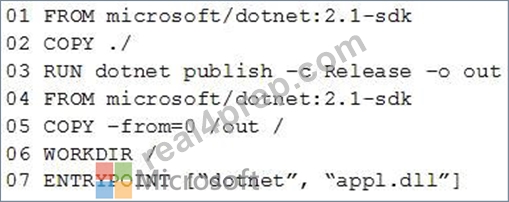
You need to ensure that the image is as small as possible when the image is built.
Which line should you modify in the file?
- A. 0
- B. 1
- C. 2
- D. 3
Answer: C
Explanation:
Explanation
https://github.com/dotnet/dotnet-docker/blob/master/samples/dotnetapp/README.md
NEW QUESTION # 192
You use Azure DevOps processes to build and deploy code.
You need to compare how much time is spent troubleshooting issues found during development and how much time is spent troubleshooting issues found in released code.
Which KPI should you use?
- A. rework rate
- B. unplanned work rate
- C. defect rate
- D. defect escape rate
Answer: A
Explanation:
Explanation
The defect escape rate is a metric that assesses the collective quality of software releases by evaluating how often errors are discovered and rectified in the pre-production process versus during production.
The defect escape rate is a KPI (Key Performance Indicator) that measures how many defects are found in released code versus how many are found during development. This KPI can help you to compare how much time is spent troubleshooting issues found during development versus how much time is spent troubleshooting issues found in released code. The higher the defect escape rate, the more defects are found in released code, and thus more time is spent troubleshooting issues in released code.
NEW QUESTION # 193
You plan to deploy a template named D:\Deploy.json to a resource group named Deploy-lod9940427.
You need to modify the template to meet the following requirements, and then to deploy the template:
* The address space must be reduced to support only 256 total IP addresses.
* The subnet address space must be reduced to support only 64 total IP addresses.
To complete this task, sign in to the Microsoft Azure portal.
- A. 1. Sign in to the portal,
2. Choose template Deploy-lod9940427
3. Select Edit template, and then paste your JSON template code into the code window.
4. Change the ASddressPrefixes to 10.0.0.0/24 in order to support only 256 total IP addresses.
addressSpace":{"addressPrefixes": ["10.0.0.0/24"]},
5. Change the firstSubnet addressprefix to 10.0.0.0/26 to support only 64 total IP addresses.
"subnets":[
{
"name":"firstSubnet",
"properties":{
"addressPrefix":"10.0.0.0/24"
}
6. Select Save.
7. Select Edit parameters, provide values for the parameters that are shown, and then select OK.
8 Select Subscription. Choose the subscription you want to use, and then select OK.
9. Select Resource group. Choose an existing resource group or create a new one, and then select OK.
10. Select Create. A new tile on the dashboard tracks the progress of your template deployment. - B. 1. Sign in to the portal,
2. Choose template Deploy-lod9940427
3. Select Edit template, and then paste your JSON template code into the code window.
4. Change the ASddressPrefixes to 10.0.0.0/24 in order to support only 256 total IP addresses.
addressSpace":{"addressPrefixes": ["10.0.0.0/24"]},
5. Change the firstSubnet addressprefix to 10.0.0.0/26 to support only 64 total IP addresses.
"subnets":[
{
"name":"firstSubnet",
"properties":{
"addressPrefix":"10.0.0.0/24"
}
6. Select Save.
7. Select Edit parameters, provide values for the parameters that are shown, and then select OK.
8 Select Subscription. Choose the subscription you want to use, and then select OK.
9. Select Resource group. Choose an existing resource group or create a new one, and then select OK.
10. Select Create. A new tile on the dashboard tracks the progress of your template deployment.
Answer: A
Explanation:
References:
https://docs.microsoft.com/en-us/azure-stack/user/azure-stack-deploy-template-portal?view=azs-1908
https://docs.microsoft.com/en-us/azure/architecture/building-blocks/extending-templates/update-resource
NEW QUESTION # 194
You need to create deployment files for an Azure Kubernetes Service (AKS) cluster. The deployments must meet the provisioning storage requirements shown in the following table.
Which resource type should you use for each deployment? To answer, select the appropriate options in the answer area.
NOTE: Each correct selection is worth one point.
Answer:
Explanation:
References:
https://docs.microsoft.com/bs-cyrl-ba/azure/aks/azure-files-dynamic-pv
https://docs.microsoft.com/en-us/azure/aks/azure-disks-dynamic-pv
NEW QUESTION # 195
Where should the build and release agents for the investment planning application suite run? To answer, select the appropriate options in the answer area.
NOTE: Each correct selection is worth one point.
Answer:
Explanation:
Explanation
Box 1: A source control system
A source control system, also called a version control system, allows developers to collaborate on code and track changes. Source control is an essential tool for multi-developer projects.
Box 2: A hosted service
To build and deploy Xcode apps or Xamarin.iOS projects, you'll need at least one macOS agent. If your pipelines are in Azure Pipelines and a Microsoft-hosted agent meets your needs, you can skip setting up a self-hosted macOS agent.
Scenario: The investment planning applications suite will include one multi-tier web application and two iOS mobile applications. One mobile application will be used by employees; the other will be used by customers.
References:
https://docs.microsoft.com/en-us/azure/devops/pipelines/agents/v2-osx?view=azure-devops
NEW QUESTION # 196 
Your company is building a new web application.
You plan to collect feedback from pilot users on the features being delivered.
All the pilot users have a corporate computer that has Google Chrome and the Microsoft Test & Feedback extension installed. The pilot users will test the application by using Chrome.
You need to identify which access levels are required to ensure that developers can request and gather feedback from the pilot users. The solution must use the principle of least privilege.
Which access levels in Azure DevOps should you identify? To answer, select the appropriate options in the answer area.
NOTE: Each correct selection is worth one point.
Answer:
Explanation:
Explanation
Graphical user interface, text, application Description automatically generated
Box 1: Basic
Assign Basic to users with a TFS CAL, with a Visual Studio Professional subscription, and to users for whom you are paying for Azure Boards & Repos in an organization.
Box 2: Stakeholder
Assign Stakeholders to users with no license or subscriptions who need access to a limited set of features.
Note:
You assign users or groups of users to one of the following access levels:
Basic: provides access to most features
VS Enterprise: provides access to premium features
Stakeholders: provides partial access, can be assigned to unlimited users for free Reference:
https://docs.microsoft.com/en-us/azure/devops/organizations/security/access-levels?view=vsts
NEW QUESTION # 197
You need to configure Azure Automation for the computers in Pool7.
Which three actions should you perform in sequence? To answer, move the appropriate actions from the list of actions to the answer area and arrange them m the correct order.
Answer:
Explanation:
NEW QUESTION # 198
Note: This question is part of a series of questions that present the same scenario. Each question in the series contains a unique solution that might meet the stated goals. Some question sets might have more than one correct solution, while others might not have a correct solution.
After you answer a question in this section, you will NOT be able to return to it. As a result, these questions will not appear in the review screen.
You have an approval process that contains a condition. The condition requires that releases be approved by a team leader before they are deployed.
You have a policy stating that approvals must occur within eight hours.
You discover that deployment fail if the approvals take longer than two hours.
You need to ensure that the deployments only fail if the approvals take longer than eight hours.
Solution: From Pre-deployment conditions, you modify the Timeout setting for pre-deployment approvals.
Does this meet the goal?
- A. Yes
- B. No
Answer: B
Explanation:
Use a gate instead of an approval instead.
References: https://docs.microsoft.com/en-us/azure/devops/pipelines/release/approvals/gates
NEW QUESTION # 199
You need to increase the security of your team's development process.
Which type of security tool should you recommend for each stage of the development process? To answer, drag the appropriate security toots to the correct stages. Each security tool may be used once, more than once, or not at all. You may need to drag the split bar between panes or scroll to view content NOTE: Each correct selection is worth one point.
Answer:
Explanation:
NEW QUESTION # 200
You are designing YAML-based Azure pipelines for the apps shown in the following table.
You need to configure the YAML strategy value for each app. The solution must minimize app downtime.
Which value should you configure for each app? To answer, select the appropriate options in the answer area.
NOTE: Each correct selection is worth one point.
Answer:
Explanation:
Explanation
App1: rolling
A rolling deployment replaces instances of the previous version of an application with instances of the new version of the application on a fixed set of virtual machines (rolling set) in each iteration.
App2: canary
Canary deployment strategy is an advanced deployment strategy that helps mitigate the risk involved in rolling out new versions of applications. By using this strategy, you can roll out the changes to a small subset of servers first. As you gain more confidence in the new version, you can release it to more servers in your infrastructure and route more traffic to it.
Reference:
https://docs.microsoft.com/en-us/azure/devops/pipelines/process/deployment-jobs
NEW QUESTION # 201
How should you configure the filters for the Project5 trigger? To answer, select the appropriate option in the answer area.
NOTE: Each correct selection is worth one point.
Answer:
Explanation:
Explanation
Scenario:
References: https://docs.microsoft.com/en-us/azure/devops/pipelines/build/triggers
NEW QUESTION # 202
You need to execute inline testing of an Azure DevOps pipeline that uses a Docker deployment model. The solution must prevent the results from being published to the pipeline.
What should you use for the inline testing?
- A. an Azure Kubernetes Service (AKS) pod
- B. a multi-stage Dockerfile
- C. a Docker Compose file
- D. a single stage Dockerfile
Answer: B
Explanation:
Explanation
"Build and test with a multi-stage Dockerfile: build and tests execute inside the container using a multi-stage Docker file, as such test results are not published back to the pipeline."
https://docs.microsoft.com/en-us/azure/devops/pipelines/tasks/test/publish-test-results?view=azure-devops&tabs
NEW QUESTION # 203
You are deploying a server application that will run on a Server Core installation of Windows Server 2019.
You create an Azure key vault and a secret.
You need to use the key vault to secure API secrets for third-party integrations.
Which three actions should you perform? Each correct answer presents part of the solution.
NOTE: Each correct selection is worth one point.
D18912E1457D5D1DDCBD40AB3BF70D5D
- A. Configure RBAC for the key vault.
- B. Deploy a virtual machine that uses a system-assigned managed identity.
- C. Configure a Key Vault access policy.
- D. Modify the application to access the key vault.
- E. Deploy an Azure Desired State Configuration (DSC) extension.
Answer: B,C,D
Explanation:
BE: An app deployed to Azure can take advantage of Managed identities for Azure resources, which allows the app to authenticate with Azure Key Vault using Azure AD authentication without credentials (Application ID and Password/Client Secret) stored in the app.
Select Add Access Policy.
Open Secret permissions and provide the app with Get and List permissions.
Select Select principal and select the registered app by name. Select the Select button.
Select OK.
Select Save.
Deploy the app.
Reference:
https://docs.microsoft.com/en-us/aspnet/core/security/key-vault-configuration
https://docs.microsoft.com/en-us/azure/key-vault/general/tutorial-net-virtual-machine
NEW QUESTION # 204
You are configuring Azure Pipelines for three projects in Azure DevOps as shown in the following table.
Which version control system should you recommend for each project? To answer, drag the appropriate version control systems to the correct projects. Each version control system may be used once, more than once, or not at all. You may need to drag the split bar between panes or scroll to view content.
NOTE: Each correct selection is worth one point.
Answer:
Explanation: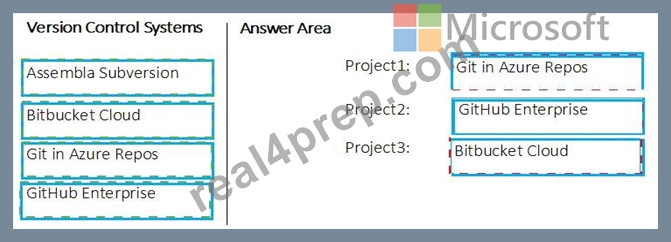
Explanation
Project1:Git in Azure Repos
Project2: Github Enterprise
GitHub Enterprise is the on-premises version of GitHub.com. GitHub Enterprise includes the same great set of features as GitHub.com but packaged for running on your organization's local network. All repository data is stored on machines that you control, and access is integrated with your organization's authentication system (LDAP, SAML, or CAS).
Project3: Bitbucket cloud
One downside, however, is that Bitubucket does not include support for SVN but this can be easily amended migrating the SVN repos to Git with tools such as SVN Mirror for Bitbucket .
Note: SVN is a centralized version control system.
NEW QUESTION # 205
Note: This question is part of * series of questions that present the same scenario. Each question in the series contains a unique solution that might meet the stated goals. Some question sett might have more than one correct solution, while others might not have a correct solution.
After you answer a question in this section, you will NOT be able to return to it. As a result, these questions will not appear in the review screen.
You have an approval process that contains a condition. The condition requires that releases be approved by a team leader before they are deployed.
You have a poky stating that approvals must occur within eight hour.
You discover that deployments fail if the approvals take longer than two hours.
You need to ensure that the deployments only fail if the approvals take longer than eight hours.
Solution: From Post-deployment conditions, you modify the Time between re-evaluation of gates option.
Does this meet the goal?
- A. Yes
- B. No
Answer: B
Explanation:
Explanation
Use a gate From Pre-deployment conditions instead.
References: https://docs.microsoft.com/en-us/azure/devops/pipelines/release/approvals/gates
NEW QUESTION # 206
You have the Azure DevOps pipeline shown in the following exhibit.
Use the drop-down menus to select the answer choice that completes each statement based on the information presented in the graphic.
Answer:
Explanation:
Explanation
Box 1: 1
The Cloud agent job only.
Box 2: 4
The pipelines has the four tasks: NuGet restore, Compile Application, Copy Files, and Publish Artifact.
Reference:
https://azuredevopslabs.com/labs/azuredevops/continuousintegration/
NEW QUESTION # 207
You need to recommend a solution for deploying charts by using Helm and Title to Azure Kubemets Service (AKS) in an RBAC-enabled cluster.
Which three commands should you recommend be run m sequence? To answer, move the appropriate commands from the list of commands to the answer area and arrange them in the correct order.
Answer:
Explanation:
Explanation
Step 1: Kubectl create
You can add a service account to Tiller using the --service-account <NAME> flag while you're configuring Helm (step 2 below). As a prerequisite, you'll have to create a role binding which specifies a role and a service account name that have been set up in advance.
Example: Service account with cluster-admin role
$ kubectl create -f rbac-config.yaml
serviceaccount "tiller" created
clusterrolebinding "tiller" created
$ helm init --service-account tiller
Step 2: helm init
To deploy a basic Tiller into an AKS cluster, use the helm init command.
Step 3: helm install
To install charts with Helm, use the helm install command and specify the name of the chart to install.
References:
https://docs.microsoft.com/en-us/azure/aks/kubernetes-helm
https://docs.helm.sh/using_helm/#tiller-namespaces-and-rbac
NEW QUESTION # 208
......
Prepare With Top Rated High-quality AZ-400 Dumps For Success in Exam: https://www.real4prep.com/AZ-400-exam.html
Get Totally Free Updates on AZ-400 Dumps PDF Questions: https://drive.google.com/open?id=1qMjy4p845KQ5Qf_5YPe5pV3TUBCfZwZ1