


Pass Cloud Security Engineer CloudSec-Pro exam [Jul 21, 2026] Updated 332 Questions
Palo Alto Networks CloudSec-Pro Actual Questions and 100% Cover Real Exam Questions
Palo Alto Networks CloudSec-Pro Exam Syllabus Topics:
| Topic | Details |
|---|---|
| Topic 1 |
|
| Topic 2 |
|
| Topic 3 |
|
| Topic 4 |
|
| Topic 5 |
|
NEW QUESTION # 163
What are the subtypes of configuration policies in Prisma Cloud?
- A. Build and Deploy
- B. Monitor and Analyze
- C. Build and Run
- D. Security and Compliance
Answer: C
Explanation:
In Prisma Cloud, configuration policies are categorized to align with the different phases of the cloud security lifecycle, emphasizing a holistic approach to cloud security management. The subtypes "Build and Run" encapsulate this approach by covering both the development phase (Build) - where cloud resources and applications are designed and created, and the operational phase (Run) - where these resources and applications are deployed and actively used. This categorization ensures that security and compliance are integral throughout the lifecycle, from the initial creation of cloud infrastructure and applications to their deployment and day-to-day operation, thereby enhancing the overall security posture.
NEW QUESTION # 164
Which two CI/CD plugins are supported by Prisma Cloud as part of its Code Security? (Choose two.)
- A. Visual Studio Code
- B. CircleCI
- C. Checkov
- D. IntelliJ
Answer: B,C
Explanation:
https://live.paloaltonetworks.com/t5/blogs/what-is-changing-for-ci-cd-plugins/ba-p/461676 Prisma Cloud has announced changes to its CI/CD plugins due to the acquisition of Bridgecrew1. The existing IaC functionality in Prisma Cloud will be replaced by a Prisma "cloud code security" (CCS) module that delivers Bridgecrew integration in Prisma Cloud1. As part of this change, several CI/CD plugins that Prisma Cloud currently uses will either be replaced or modified1.
According to the information from the link, both Checkov and CircleCI are listed as integrations that will switch to the Prisma "cloud code security" (CCS) module1. Checkov is an open-source command-line interface (CLI) utility that includes more than 750 predefined policies and supports custom policies1. CircleCI is a continuous integration and continuous delivery platform1.
NEW QUESTION # 165
In which scenario is using application security over data security more appropriate?
- A. Detecting sensitive data
- B. Protecting data in real time
- C. Monitoring CI/CD pipelines
- D. Accessing visibility to cloud assets
Answer: C
Explanation:
Application security is more appropriate for monitoring CI/CD pipelines because it focuses on securing the software development lifecycle, including code repositories, build systems, and deployment workflows.
NEW QUESTION # 166
Which ban for DoS protection will enforce a rate limit for users who are unable to post five (5) ".
tar.gz" files within five (5) seconds?
- A. One with an average rate of 5 and file extensions match on ". tar.gz" on Cloud Native Network Firewall (CNNF)
- B. One with an average rate of 5 and file extensions match on ". tar.gz" on Web Application and API Security (WAAS)
- C. One with a burst rate of 5 and file extensions match on ". tar.gz" on Cloud Native Network Firewall (CNNF)
- D. One with a burst rate of 5 and file extensions match on ". tar.gz" on Web Application and API Security (WAAS) *
Answer: B
Explanation:
In the context of DoS protection, enforcing a rate limit is a common strategy to prevent abuse and ensure service availability. The scenario described involves limiting the rate at which users can post ".tar.gz" files to five within five seconds. The correct ban configuration for this requirement would be one that specifies an average rate of 5 with a file extension match on ".tar.gz" within the Web Application and API Security (WAAS) component of a security solution like Prisma Cloud.
WAAS is designed to protect web applications and APIs from various threats, including DoS attacks, by applying policies that can limit actions based on specific criteria, such as file types and request rates. This configuration ensures that any attempt to upload more than five ".tar.gz" files within a five-second window would be detected and blocked, mitigating the risk of DoS attacks targeting this particular file upload functionality.
NEW QUESTION # 167
In which two ways can Prisma Cloud images be retrieved in Prisma Cloud Compute Self-Hosted Edition? (Choose two.)
- A. Pull the images from the Prisma Cloud registry without any authentication.
- B. Authenticate with Prisma Cloud registry, and then pull the images from the Prisma Cloud registry.
- C. Retrieve Prisma Cloud images using URL auth by embedding an access token.
- D. Download Prisma Cloud images from github.paloaltonetworks.com.
Answer: B,C
Explanation:
In Prisma Cloud Compute Self-Hosted Edition, images can be retrieved by first authenticating with the Prisma Cloud registry and then pulling the images from the Prisma Cloud registry. This process ensures secure access to Prisma Cloud images, as authentication is required to access the registry. By using authentication, Prisma Cloud ensures that only authorized users can retrieve and deploy Prisma Cloud images, maintaining the security and integrity of the deployment.
NEW QUESTION # 168
The administrator wants to review the Console audit logs from within the Console.
Which page in the Console should the administrator use to review this data, if it can be reviewed at all?
- A. Navigate to Monitor > Events > Host Log Inspection
- B. Navigate to Manage > View Logs > History
- C. The audit logs can be viewed only externally to the Console
- D. Navigate to Manage > Defenders > View Logs
Answer: B
Explanation:
https://docs.paloaltonetworks.com/prisma/prisma-cloud/prisma-cloud-admin-compute/audit
/audit_admin_activity
NEW QUESTION # 169
A customer wants to harden its environment from misconfiguration. Prisma Cloud Compute Compliance enforcement for hosts covers which three options? (Choose three.)
- A. Host cloud provider tags
- B. Host configuration
- C. Docker daemon configuration files
- D. Docker daemon configuration
- E. Hosts without Defender agents
Answer: B,C,D
Explanation:
Prisma Cloud Compute Compliance enforcement for hosts covers several aspects to ensure a secure and compliant host environment, particularly within containerized environments. These include:
Docker daemon configuration files: Ensuring that Docker daemon configuration files are set up according to best security practices is crucial. These files contain various settings that control the behavior of the Docker daemon, and misconfigurations can lead to security vulnerabilities.
Docker daemon configuration: Beyond just the configuration files, the overall configuration of the Docker daemon itself is critical. This encompasses runtime settings and command-line options that determine how Docker containers are executed and managed on the host.
Host configuration: The security of the underlying host on which Docker and other container runtimes are installed is paramount. This includes the configuration of the host's operating system, network settings, file permissions, and other system-level settings that can impact the security of the containerized applications running on top.
By focusing on these areas, Prisma Cloud ensures that not just the containers but also the environment they run in is secure, adhering to compliance standards and best practices to mitigate risks associated with containerized deployments.
NEW QUESTION # 170
Drag and Drop Question
Order the steps involved in onboarding an AWS Account for use with Data Security feature.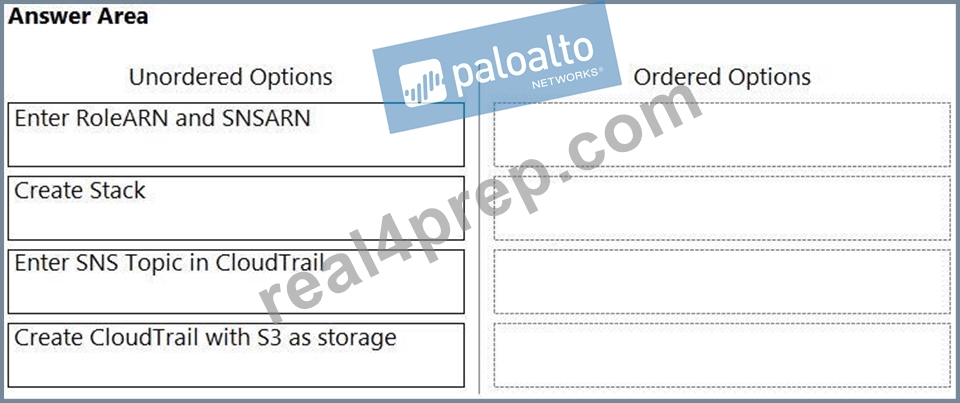
Answer:
Explanation:
NEW QUESTION # 171
Drag and Drop Question
Put the steps of integrating Okta with Prisma Cloud in the right order in relation to CIEM or SSO okra integration.
Answer:
Explanation:
NEW QUESTION # 172
Where are Top Critical CVEs for deployed images found?
- A. Defend # Vulnerabilities # Images
- B. Defend # Vulnerabilities # Code Repositories
- C. Monitor # Vulnerabilities # Images
- D. Monitor # Vulnerabilities # Vulnerabilities Explorer
Answer: D
Explanation:
https://docs.paloaltonetworks.com/prisma/prisma-cloud/prisma-cloud-admin-compute
/vulnerability_management/vuln_explorer
The top critical CVEs (Common Vulnerabilities and Exposures) for deployed images in Prisma Cloud can be found in the Vulnerabilities Explorer under the Monitor tab. This is where users can input the CVE of interest and get a filtered list of images impacted by that CVE. The Vulnerability Explorer provides a comprehensive view of the vulnerabilities, allowing users to see details such as risk score, CVE risk factors, environmental risk factors, and impacted packages1. This tool is essential for identifying and managing vulnerabilities within your cloud environment, ensuring that all images pulled into deployments or test environments are properly identified and secured.
https://knowledgebase.paloaltonetworks.com/KCSArticleDetail?id=kA14u0000004MfoCAE
NEW QUESTION # 173
Prisma Cloud supports which three external systems that allow the import of vulnerabilities and provide additional context on risks in the cloud? (Choose three.)
- A. Amazon Inspector
- B. Qualys
- C. ServiceNow
- D. Splunk
- E. Amazon GuardDuty
Answer: A,B,E
Explanation:
Similarly, Prisma Cloud integration with external systems such as Amazon GuardDuty, AWS Inspector, Qualys, and Tenable allow you to import vulnerabilities and provide additional context on risks in the cloud.
https://docs.paloaltonetworks.com/prisma/prisma-cloud/prisma-cloud-admin/configure-external-integrations- on-prisma-cloud
NEW QUESTION # 174
Given the following audit event activity snippet:
Which RQL will be triggered by the audit event?
A)
B)
C)
D)
- A. Option C
- B. Option B
- C. Option A
- D. Option D
Answer: D
NEW QUESTION # 175
Which two statements are true about the differences between build and run config policies? (Choose two.)
- A. Build policies enable you to check for security misconfigurations in the IaC templates and ensure that these issues do not get into production.
- B. Build and Audit Events policies belong to the configuration policy set.
- C. Run policies monitor resources, and check for potential issues after these cloud resources are deployed.
- D. Run and Network policies belong to the configuration policy set.
- E. Run policies monitor network activities in your environment, and check for potential issues during runtime.
Answer: A,C
Explanation:
In the context of Prisma Cloud, Build and Run policies serve distinct purposes in securing cloud environments. Build policies are designed to evaluate Infrastructure as Code (IaC) templates before deployment. These policies help identify and remediate security misconfigurations in the development phase, ensuring that vulnerabilities are addressed before the infrastructure is provisioned. This proactive approach enhances security by preventing misconfigurations from reaching production environments.
On the other hand, Run policies are applied to resources that are already deployed in the cloud. These policies continuously monitor the cloud environment, detecting and alerting on potential security issues that arise in the runtime. Run policies help maintain the security posture of cloud resources by identifying deviations from established security baselines and enabling quick remediation of identified issues.
Both Build and Run policies are integral to a comprehensive cloud security strategy, addressing security concerns at different stages of the cloud resource lifecycle-from development and deployment to ongoing operation.
NEW QUESTION # 176
Which role must be assigned to DevOps users who need access to deploy Container and Host Defenders in Compute?
- A. Build and Deploy Security
- B. Cloud Provisioning Admin
- C. System Admin
- D. Developer
Answer: B
Explanation:
Cloud Provisioning Admin (Defender Manager) DevOps team members that need to manage Defender deployments without sysadmin privileges. https://docs.paloaltonetworks.com/prisma/prisma-cloud/prisma- cloud-admin-compute/authentication/prisma_cloud_user_roles
NEW QUESTION # 177
Given an existing ECS Cluster, which option shows the steps required to install the Console in Amazon ECS?
- A. Download and extract the release tarballEnsure that each node has its own storage for Console data Create the Console task definitionDeploy the task definition
- B. The console cannot natively run in an ECS cluster. A onebox deployment should be used.
- C. Download and extract the release tarball Create an EFS file system and mount to each node in the cluster Create the Console task definition Deploy the task definition
- D. Download and extract release tarball Download task from AWSCreate the Console task definition Deploy the task definition
Answer: C
Explanation:
To install the Console in an Amazon ECS Cluster, the steps involve downloading and extracting the release tarball, which contains the necessary files for the Console. Then, an Amazon Elastic File System (EFS) should be created and mounted to each node in the ECS cluster to provide shared storage for Console data. Following this, a Console task definition needs to be created in ECS, which defines how the Console container should run. Finally, this task definition is deployed to the ECS cluster to start the Console.
NEW QUESTION # 178
In WAAS Access control file upload controls, which three file types are supported out of the box?
(Choose three.)
- A. Audio
- B. Journal
- C. Documents
- D. Images
- E. Text
Answer: C,D,E
Explanation:
In WAAS Access control for file uploads, Prisma Cloud supports various file types out-of-the-box to ensure secure and controlled file upload functionality. The supported file types include Text, Images, and Documents. These categories cover a wide range of commonly used file formats, allowing organizations to manage and restrict file uploads based on the content type. This feature helps in preventing malicious file uploads and ensures that only approved file types are uploaded to applications and services.
NEW QUESTION # 179
What is a lightweight solution that provides runtime visibility into an OpenShift cluster?
- A. Cortex XDR for Cloud
- B. Agentless disk scanning
- C. Kubernetes Connector
- D. Data broker
Answer: C
Explanation:
The Kubernetes Connector is a lightweight integration that provides runtime visibility into Kubernetes and OpenShift clusters without requiring heavy agent deployment, enabling monitoring of workloads, configurations, and runtime activity.
NEW QUESTION # 180
......
Palo Alto Networks CloudSec-Pro Real 2026 Braindumps Mock Exam Dumps: https://www.real4prep.com/CloudSec-Pro-exam.html