


Feb-2025 Realistic DP-700 Accurate & Verified Answers As Experienced in the Actual Test!
Latest Microsoft DP-700 Practice Test Questions, Implementing Data Engineering Solutions Using Microsoft Fabric Exam Dumps
NEW QUESTION # 35
You have a Fabric deployment pipeline that uses three workspaces named Dev, Test, and Prod.
You need to deploy an eventhouse as part of the deployment process.
What should you use to add the eventhouse to the deployment process?
- A. GitHub Actions
- B. a deployment pipeline
- C. an Azure DevOps pipeline
Answer: B
Explanation:
A deployment pipeline in Fabric is designed to automate the process of deploying assets (such as reports, datasets, eventhouses, and other objects) between environments like Dev, Test, and Prod. Since you need to deploy an eventhouse as part of the deployment process, a deployment pipeline is the appropriate tool to move this asset through the different stages of your environment.
NEW QUESTION # 36
Note: This question is part of a series of questions that present the same scenario. Each question in the series contains a unique solution that might meet the stated goals. Some question sets might have more than one correct solution, while others might not have a correct solution.
After you answer a question in this section, you will NOT be able to return to it. As a result, these questions will not appear in the review screen.
You have a KQL database that contains two tables named Stream and Reference. Stream contains streaming data in the following format.
Reference contains reference data in the following format.
Both tables contain millions of rows.
You have the following KQL queryset.
You need to reduce how long it takes to run the KQL queryset.
Solution: You change the join type to kind=outer.
Does this meet the goal?
- A. Yes
- B. No
Answer: B
Explanation:
An outer join will include unmatched rows from both tables, increasing the dataset size and processing time. It does not improve query performance.
NEW QUESTION # 37
You have a Fabric workspace that contains an eventstream named Eventstream1. Eventstream1 processes data from a thermal sensor by using event stream processing, and then stores the data in a lakehouse.
You need to modify Eventstream1 to include the standard deviation of the temperature.
Which transform operator should you include in the Eventstream1 logic?
- A. Aggregate
- B. Group by
- C. Union
- D. Expand
Answer: A
Explanation:
To compute the standard deviation of the temperature from the thermal sensor data, you would use the Aggregate transform operator in Eventstream1. The Aggregate operator allows you to apply functions like sum, average, count, and statistical functions like standard deviation across a group of rows or events. This operator is ideal for operations that require summarizing or computing statistics over a dataset, such as calculating the standard deviation.
NEW QUESTION # 38
You need to schedule the population of the medallion layers to meet the technical requirements.
What should you do?
- A. Schedule a notebook.
- B. Schedule multiple data pipelines.
- C. Schedule a data pipeline that calls other data pipelines.
- D. Schedule an Apache Spark job.
Answer: C
Explanation:
The technical requirements specify that:
Why Use a Data Pipeline That Calls Other Data Pipelines?
- Sequential execution of child pipelines.
- Error handling to send email notifications upon failures.
- Parallel execution of tasks where possible (e.g., simultaneous imports into the bronze layer).
NEW QUESTION # 39
You have a Fabric workspace that contains a Real-Time Intelligence solution and an eventhouse.
Users report that from OneLake file explorer, they cannot see the data from the eventhouse.
You enable OneLake availability for the eventhouse.
What will be copied to OneLake?
- A. only data added to new databases that are added to the eventhouse
- B. only the existing data in the eventhouse
- C. no data
- D. both new data and existing data in the eventhouse
- E. only new data added to the eventhouse
Answer: D
Explanation:
When you enable OneLake availability for an eventhouse, both new and existing data in the eventhouse will be copied to OneLake. This feature ensures that data, whether newly ingested or already present, becomes available for access through OneLake, making it easier for users to interact with and explore the data directly from OneLake file explorer.
NEW QUESTION # 40
You have a Fabric capacity that contains a workspace named Workspace1. Workspace1 contains a lakehouse named Lakehouse1, a data pipeline, a notebook, and several Microsoft Power BI reports.
A user named User1 wants to use SQL to analyze the data in Lakehouse1.
You need to configure access for User1. The solution must meet the following requirements:
What should you do?
- A. Assign User1 the Member role for Workspace1. Share Lakehouse1 with User1 and select Read all SQL endpoint data.
- B. Share Lakehouse1 with User1 directly and select Read all SQL endpoint data.
- C. Share Lakehouse1 with User1 directly and select Build reports on the default semantic model.
- D. Assign User1 the Viewer role for Workspace1. Share Lakehouse1 with User1 and select Read all SQL endpoint data.
Answer: D
Explanation:
To meet the specified requirements for User1, the solution must ensure:
Read access to the table data in Lakehouse1: User1 needs permission to access the data within Lakehouse1. By sharing Lakehouse1 with User1 and selecting the Read all SQL endpoint data option, User1 will be able to query the data via SQL endpoints.
Prevent Apache Spark usage: By sharing the lakehouse directly and selecting the SQL endpoint data option, you specifically enable SQL-based access to the data, preventing User1 from using Apache Spark to query the data.
Prevent access to other items in Workspace1: Assigning User1 the Viewer role for Workspace1 ensures that User1 can only view the shared items (in this case, Lakehouse1), without accessing other resources such as notebooks, pipelines, or Power BI reports within Workspace1.
This approach provides the appropriate level of access while restricting User1 to only the required resources and preventing access to other workspace assets.
NEW QUESTION # 41
You have an Azure event hub. Each event contains the following fields:
BikepointID
Street
Neighbourhood
Latitude
Longitude
No_Bikes
No_Empty_Docks
You need to ingest the events. The solution must only retain events that have a Neighbourhood value of Chelsea, and then store the retained events in a Fabric lakehouse.
What should you use?
- A. a streaming dataset
- B. Apache Spark Structured Streaming
- C. a KQL queryset
- D. an eventstream
Answer: D
Explanation:
An eventstream is the best solution for ingesting data from Azure Event Hub into Fabric, while applying filtering logic such as retaining only the events that have a Neighbourhood value of "Chelsea." Eventstreams in Microsoft Fabric are designed for handling real-time data streams and can apply transformation logic directly on incoming events. In this case, the eventstream can filter events based on the Neighbourhood field before storing the retained events in a Fabric lakehouse.
Eventstreams are well-suited for stream processing, such as this case where you need to filter out only specific data (events with a Neighbourhood of "Chelsea") before storing it in the lakehouse.
NEW QUESTION # 42
You have a Fabric workspace named Workspace1 that contains an Apache Spark job definition named Job1.
You have an Azure SQL database named Source1 that has public internet access disabled.
You need to ensure that Job1 can access the data in Source1.
What should you create?
- A. an on-premises data gateway
- B. an integration runtime
- C. a data management gateway
- D. a managed private endpoint
Answer: D
Explanation:
To allow Job1 in Workspace1 to access an Azure SQL database (Source1) with public internet access disabled, you need to create a managed private endpoint. A managed private endpoint is a secure, private connection that enables services like Fabric (or other Azure services) to access resources such as databases, storage accounts, or other services within a virtual network (VNet) without requiring public internet access. This approach maintains the security and integrity of your data while enabling access to the Azure SQL database.
NEW QUESTION # 43
You have a Fabric workspace that contains an eventstream named EventStream1. EventStream1 outputs events to a table in a lakehouse.
You need to remove files that are older than seven days and are no longer in use.
Which command should you run?
- A. COMPUTE
- B. VACUUM
- C. OPTIMIZE
- D. CLONE
Answer: B
Explanation:
VACUUM is used to clean up storage by removing files no longer in use by a Delta table. It removes old and unreferenced files from Delta tables. For example, to remove files older than 7 days:
VACUUM delta.`/path_to_table` RETAIN 7 HOURS;
NEW QUESTION # 44
You have a Fabric workspace named Workspace1 that contains a notebook named Notebook1.
In Workspace1, you create a new notebook named Notebook2.
You need to ensure that you can attach Notebook2 to the same Apache Spark session as Notebook1.
What should you do?
- A. Enable high concurrency for notebooks.
- B. Enable dynamic allocation for the Spark pool.
- C. Change the runtime version.
- D. Increase the number of executors.
Answer: A
Explanation:
To ensure that Notebook2 can attach to the same Apache Spark session as Notebook1, you need to enable high concurrency for notebooks. High concurrency allows multiple notebooks to share a Spark session, enabling them to run within the same Spark context and thus share resources like cached data, session state, and compute capabilities. This is particularly useful when you need notebooks to run in sequence or together while leveraging shared resources.
NEW QUESTION # 45
You need to resolve the sales data issue. The solution must minimize the amount of data transferred.
What should you do?
- A. Spilt the dataflow into two dataflows.
- B. Configure scheduled refresh for the dataflow.
- C. Configure incremental refresh for the dataflow. Set Refresh rows from the past to 1 Year.
- D. Configure incremental refresh for the dataflow. Set Refresh rows from the past to 1 Month.
- E. Configure incremental refresh for the dataflow. Set Store rows from the past to 1 Month.
Answer: D
Explanation:
The sales data issue can be resolved by configuring incremental refresh for the dataflow. Incremental refresh allows for only the new or changed data to be processed, minimizing the amount of data transferred and improving performance.
The solution specifies that data older than one month never changes, so setting the refresh period to 1 Month is appropriate. This ensures that only the most recent month of data will be refreshed, reducing unnecessary data transfers.
NEW QUESTION # 46
You have a Fabric eventhouse that contains a KQL database. The database contains a table named TaxiData. The following is a sample of the data in TaxiData.
You need to build two KQL queries. The solution must meet the following requirements:
How should you complete each query? To answer, drag the appropriate values the correct targets. Each value may be used once, more than once, or not at all. You may need to drag the split bar between panes or scroll to view content.
NOTE: Each correct selection is worth one point.
Answer:
Explanation:
NEW QUESTION # 47
You have a Fabric workspace that contains a lakehouse and a notebook named Notebook1. Notebook1 reads data into a DataFrame from a table named Table1 and applies transformation logic. The data from the DataFrame is then written to a new Delta table named Table2 by using a merge operation.
You need to consolidate the underlying Parquet files in Table1.
Which command should you run?
- A. BROADCAST
- B. VACUUM
- C. OPTIMIZE
- D. CACHE
Answer: C
Explanation:
To consolidate the underlying Parquet files in Table1 and improve query performance by optimizing the data layout, you should use the OPTIMIZE command in Delta Lake. The OPTIMIZE command coalesces smaller files into larger ones and reorganizes the data for more efficient reads. This is particularly useful when working with large datasets in Delta tables, as it helps reduce the number of files and improves performance for subsequent queries or operations like MERGE.
NEW QUESTION # 48
You have a Fabric workspace named Workspace1 that contains a notebook named Notebook1.
In Workspace1, you create a new notebook named Notebook2.
You need to ensure that you can attach Notebook2 to the same Apache Spark session as Notebook1.
What should you do?
- A. Enable high concurrency for notebooks.
- B. Enable dynamic allocation for the Spark pool.
- C. Change the runtime version.
- D. Increase the number of executors.
Answer: A
Explanation:
To ensure that Notebook2 can attach to the same Apache Spark session as Notebook1, you need to enable high concurrency for notebooks. High concurrency allows multiple notebooks to share a Spark session, enabling them to run within the same Spark context and thus share resources like cached data, session state, and compute capabilities. This is particularly useful when you need notebooks to run in sequence or together while leveraging shared resources.
NEW QUESTION # 49
You have two Fabric workspaces named Workspace1 and Workspace2.
You have a Fabric deployment pipeline named deployPipeline1 that deploys items from Workspace1 to Workspace2. DeployPipeline1 contains all the items in Workspace1.
You recently modified the items in Workspaces1.
The workspaces currently contain the items shown in the following table.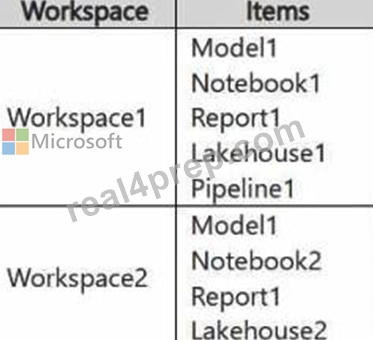
Items in Workspace1 that have the same name as items in Workspace2 are currently paired.
You need to ensure that the items in Workspace1 overwrite the corresponding items in Workspace2. The solution must minimize effort.
What should you do?
- A. Rename each item in Workspace2 to have the same name as the items in Workspace1.
- B. Run deployPipeline1 without modifying the items in Workspace2.
- C. Back up the items in Workspace2, and then run deployPipeline1.
- D. Delete all the items in Workspace2, and then run deployPipeline1.
Answer: B
Explanation:
When running a deployment pipeline in Fabric, if the items in Workspace1 are paired with the corresponding items in Workspace2 (based on the same name), the deployment pipeline will automatically overwrite the existing items in Workspace2 with the modified items from Workspace1. There's no need to delete, rename, or back up items manually unless you need to keep versions. By simply running deployPipeline1, the pipeline will handle overwriting the existing items in Workspace2 based on the pairing, ensuring the latest version of the items is deployed with minimal effort.
NEW QUESTION # 50
You need to ensure that the data analysts can access the gold layer lakehouse.
What should you do?
- A. Share the lakehouse with the DataAnalysts group and grant the Read all Apache Spark permission.
- B. Share the lakehouse with the DataAnalysts group and grant the Read all SQL Endpoint data permission.
- C. Share the lakehouse with the DataAnalysts group and grant the Build reports on the default semantic model permission.
- D. Add the DataAnalyst group to the Viewer role for WorkspaceA.
Answer: B
Explanation:
Data Analysts' Access Requirements must only have read access to the Delta tables in the gold layer and not have access to the bronze and silver layers.
The gold layer data is typically queried via SQL Endpoints. Granting the Read all SQL Endpoint data permission allows data analysts to query the data using familiar SQL-based tools while restricting access to the underlying files.
NEW QUESTION # 51
You have a Fabric workspace that contains an eventstream named EventStream1.
You discover that an EventStream1 transformation fails.
You need to find the following error information:
The error details, including the occurrence time
The total number of errors
What should you use? To answer, select the appropriate options in the answer area.
NOTE: Each correct selection is worth one point.
Answer:
Explanation: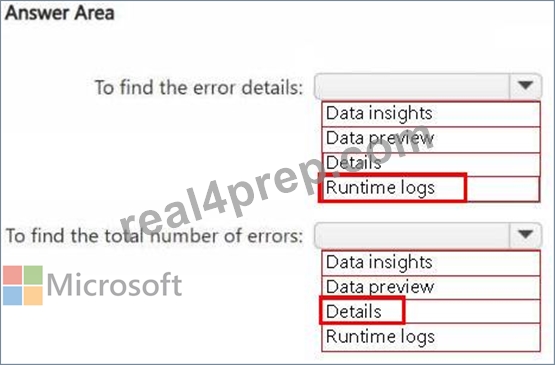
NEW QUESTION # 52
Note: This question is part of a series of questions that present the same scenario. Each question in the series contains a unique solution that might meet the stated goals. Some question sets might have more than one correct solution, while others might not have a correct solution.
After you answer a question in this section, you will NOT be able to return to it. As a result, these questions will not appear in the review screen.
You have a KQL database that contains two tables named Stream and Reference. Stream contains streaming data in the following format.
Reference contains reference data in the following format.
Both tables contain millions of rows.
You have the following KQL queryset.
You need to reduce how long it takes to run the KQL queryset.
Solution: You move the filter to line 02.
Does this meet the goal?
- A. Yes
- B. No
Answer: A
Explanation:
Moving the filter to line 02: Filtering the Stream table before performing the join operation reduces the number of rows that need to be processed during the join. This is an effective optimization technique for queries involving large datasets.
NEW QUESTION # 53
You need to create the product dimension.
How should you complete the Apache Spark SQL code? To answer, select the appropriate options in the answer area.
NOTE: Each correct selection is worth one point.
Answer:
Explanation:
NEW QUESTION # 54
You have a Fabric workspace that contains a warehouse named Warehouse1.
You have an on-premises Microsoft SQL Server database named Database1 that is accessed by using an on-premises data gateway.
You need to copy data from Database1 to Warehouse1.
Which item should you use?
- A. a notebook
- B. a data pipeline
- C. a KQL queryset
- D. a Dataflow Gen1 dataflow
Answer: B
Explanation:
To copy data from an on-premises Microsoft SQL Server database (Database1) to a warehouse (Warehouse1) in Microsoft Fabric, the best option is to use a data pipeline. A data pipeline in Fabric allows for the orchestration of data movement, from source to destination, using connectors, transformations, and scheduled workflows. Since the data is being transferred from an on-premises database and requires the use of a data gateway, a data pipeline provides the appropriate framework to facilitate this data movement efficiently and reliably.
NEW QUESTION # 55
Note: This question is part of a series of questions that present the same scenario. Each question in the series contains a unique solution that might meet the stated goals. Some question sets might have more than one correct solution, while others might not have a correct solution.
After you answer a question in this section, you will NOT be able to return to it. As a result, these questions will not appear in the review screen.
You have a Fabric eventstream that loads data into a table named Bike_Location in a KQL database. The table contains the following columns:
You need to apply transformation and filter logic to prepare the data for consumption. The solution must return data for a neighbourhood named Sands End when No_Bikes is at least 15. The results must be ordered by No_Bikes in ascending order.
Solution: You use the following code segment:
Does this meet the goal?
- A. Yes
- B. no
Answer: B
Explanation:
This code does not meet the goal because this is an SQL-like query and cannot be executed in KQL, which is required for the database.
Correct code should look like:
NEW QUESTION # 56
You have a Google Cloud Storage (GCS) container named storage1 that contains the files shown in the following table.
You have a Fabric workspace named Workspace1 that has the cache for shortcuts enabled. Workspace1 contains a lakehouse named Lakehouse1. Lakehouse1 has the shortcuts shown in the following table.
You need to read data from all the shortcuts.
Which shortcuts will retrieve data from the cache?
- A. Products and Trips only
- B. Stores and Products only
- C. Stores only
- D. Trips only
- E. Products, Stores, and Trips
- F. Products only
Answer: B
Explanation:
When reading data from shortcuts in Fabric (in this case, from a lakehouse like Lakehouse1), the cache for shortcuts helps by storing the data locally for quick access. The last accessed timestamp and the cache expiration rules determine whether data is fetched from the cache or from the source (Google Cloud Storage, in this case).
Products: The ProductFile.parquet was last accessed 12 hours ago. Since the cache has data available for up to 12 hours, it is likely that this data will be retrieved from the cache, as it hasn't been too long since it was last accessed.
Stores: The StoreFile.json was last accessed 4 hours ago, which is within the cache retention period. Therefore, this data will also be retrieved from the cache.
Trips: The TripsFile.csv was last accessed 48 hours ago. Given that it's outside the typical caching window (assuming the cache has a maximum retention period of around 24 hours), it would not be retrieved from the cache. Instead, it will likely require a fresh read from the source.
NEW QUESTION # 57
......
Free DP-700 Exam Files Downloaded Instantly 100% Dumps & Practice Exam: https://www.real4prep.com/DP-700-exam.html
Feb-2025 Pass Microsoft DP-700 Exam in First Attempt Easily: https://drive.google.com/open?id=1Th2cYR-xXljnJ1U45t8Q6swCoQHKyhEX