


2025 JN0-649 Premium Files Test pdf - Free Dumps Collection
Get ready to pass the JN0-649 Exam right now using our JNCIP-ENT Exam Package
The JN0-649 certification exam is a comprehensive exam that covers a wide range of topics related to enterprise routing and switching. JN0-649 exam tests candidates on their knowledge of network design principles, routing protocols, security, and troubleshooting. JN0-649 exam consists of multiple-choice questions and simulation questions, which require candidates to demonstrate their practical skills in a simulated environment. JN0-649 exam is designed to assess candidates' ability to design, configure, and troubleshoot enterprise level networks.
NEW QUESTION # 99
Referring to the exhibit, which statement is correct when a failure exists on the link between host2 and switch5 on this EVPN-VXLAN fabric?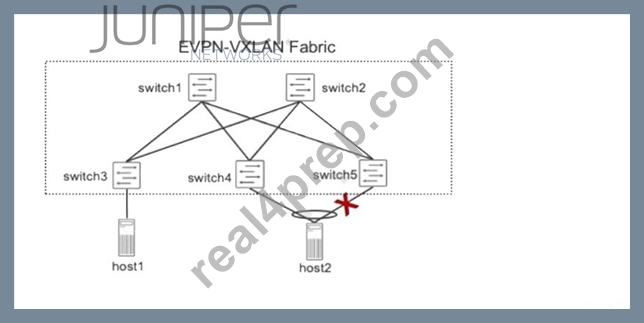
- A. The switch5 device will send a Type 1 route to all peers.
- B. The switch5 device will send a Type 2 route to all peers.
- C. The switch5 device will send a Type 4 route to all peers.
- D. The switch5 device will send a Type 3 route to all peers.
Answer: D
NEW QUESTION # 100
Which two statements are true regarding bidirectional PIM? (Choose two )
- A. It eliminates the need for an RP.
- B. Devices only store group specific entries.
- C. It uses multicast tunneling to forward traffic
- D. Forwarding paths can be suboptimal
Answer: B,D
NEW QUESTION # 101
You are running OSPF as your IGP. The interfaces connecting two routers are in the ExStart state. You notice that something is incorrect with the configuration. Referring to the exhibit, which statement is correct?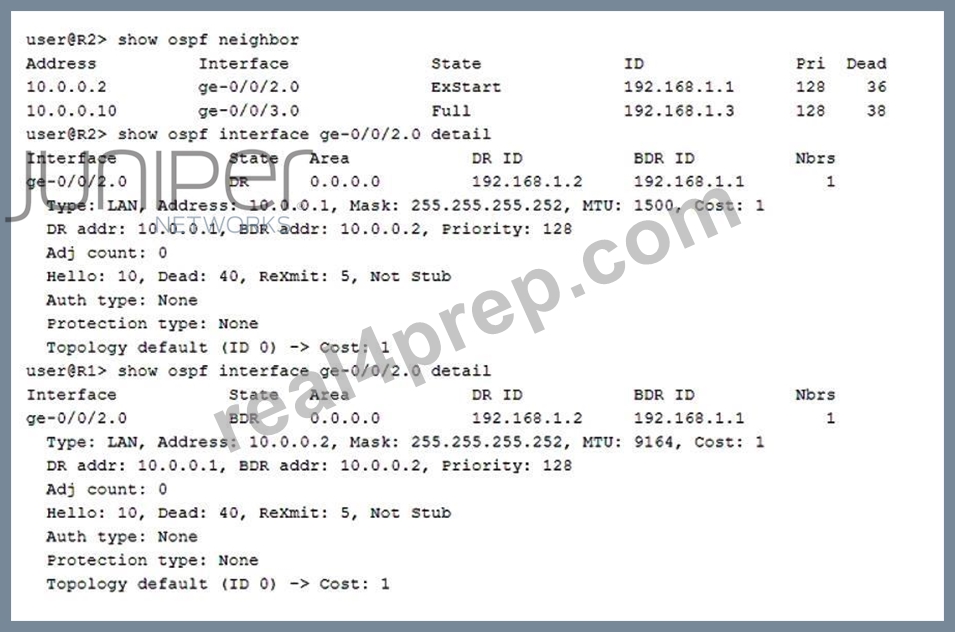
- A. The IP addresses are incorrect.
- B. The subnet mask is incorrect.
- C. The MTU setting are incorrect.
- D. The interface type is incorrect.
Answer: C
NEW QUESTION # 102
Referring to the exhibit, you have placed the cos multifield classifier on all edge interfaces and configured the relevant CoS parameters.
In this scenario, which two statements are correct? (Choose two.)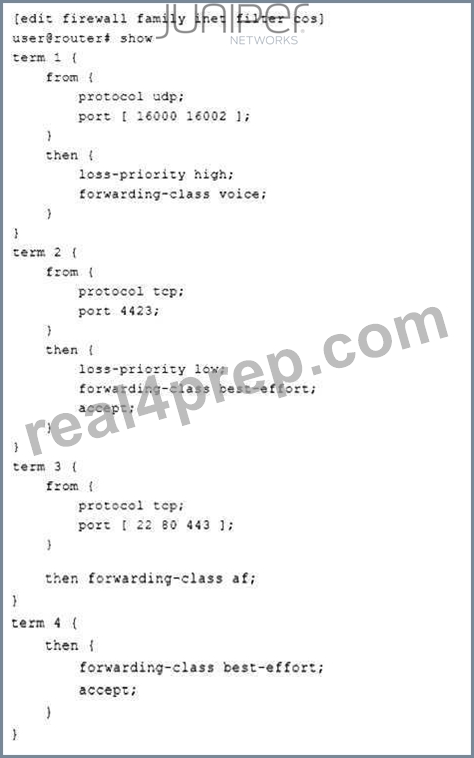
- A. SSH traffic using the default port will be placed in the af forwarding class and accepted.
- B. SSH traffic using the default port will be placed in the best-effort forwarding class and accepted.
- C. UDP traffic using the 16000 port will be placed in the voice forwarding class and accepted.
- D. UDP traffic using the 16000 port will be placed in the best-effort forwarding class and accepted.
Answer: A,C
NEW QUESTION # 103
You are deploying IP phones in your enterprise networks. When plugged in, the IP phones must be automatically provided with the correct VLAN ID needed for sending voice traffic to the EX Series switches.
In this scenario, which two solutions are required to accomplish this task? (Choose two.)
- A. Enable LLDP-MED on appropriate access interfaces.
- B. Create two VLANs and assign them as VLAN members to the appropriate access interfaces.
- C. Enable the voice VLAN feature with the appropriate access interfaces and VLAN ID for voice traffic.
- D. Use LLDP on appropriate interfaces.
Answer: A,C
Explanation:
* Enabling LLDP-MED:
* LLDP-MED (Link Layer Discovery Protocol - Media Endpoint Discovery) is an extension of LLDP specifically for VoIP devices.
* It allows network devices to advertise and receive configuration information, such as VLAN IDs, from the network switch.
* Voice VLAN Feature:
* The voice VLAN feature on switches is designed to simplify the deployment of VoIP by automatically placing voice traffic on a designated VLAN.
* Configuring the appropriate access interfaces and VLAN ID for voice traffic ensures that voice
* packets are prioritized and properly segmented from other types of traffic.
* Configuration Steps:
* Enable LLDP-MED on the appropriate access interfaces:
plaintext
Copy code
set protocols lldp-med interface ge-0/0/0
* Enable the voice VLAN feature and specify the VLAN ID:
plaintext
Copy code
set ethernet-switching-options voip interface ge-0/0/0 vlan voice
set ethernet-switching-options voip interface ge-0/0/0 forwarding-class assured-forwarding References:
* Juniper documentation on LLDP-MED
* Juniper EX Series switch configuration guide for voice VLAN
NEW QUESTION # 104
Referring to the exhibit, you have placed the cos multifield classifier on all edge interfaces and configured the relevant CoS parameters.
In this scenario, which two statements are correct? (Choose two.)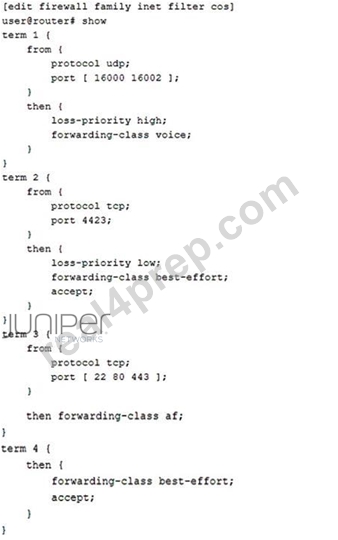
- A. SSH traffic using the default port will be placed in the af forwarding class and accepted.
- B. SSH traffic using the default port will be placed in the best-effort forwarding class and accepted.
- C. UDP traffic using the 16000 port will be placed in the voice forwarding class and accepted.
- D. UDP traffic using the 16000 port will be placed in the best-effort forwarding class and accepted.
Answer: A,C
NEW QUESTION # 105
Referring to the exhibit, which two statements are true regarding Q-in-Q tunneling? (Choose two)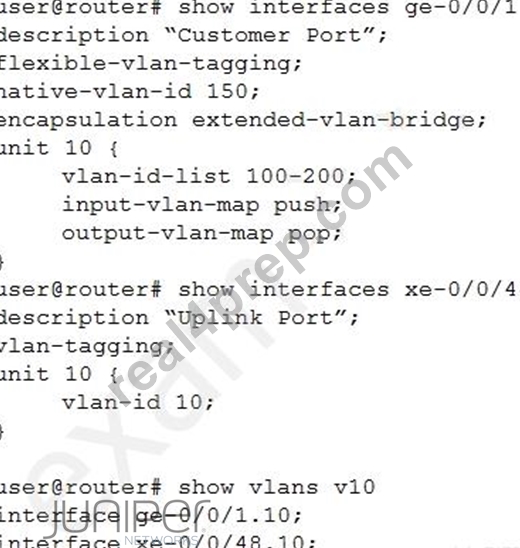
- A. The C-VLANs 100-200 will be sent as the inner VLAN tag
- B. The C-VLAN traffic will be encapsulated with an outer VLAN tag of 10.
- C. The C-VLAN traffic will be encapsulated with an outer VLAN lag of 150
- D. The C-VLAN 150 will be sent as the inner VLAN tag
Answer: A,B
NEW QUESTION # 106
You have configured 802.1X single supplicant mode on the access switch. The VoIP phone does not support 802.1X authentication.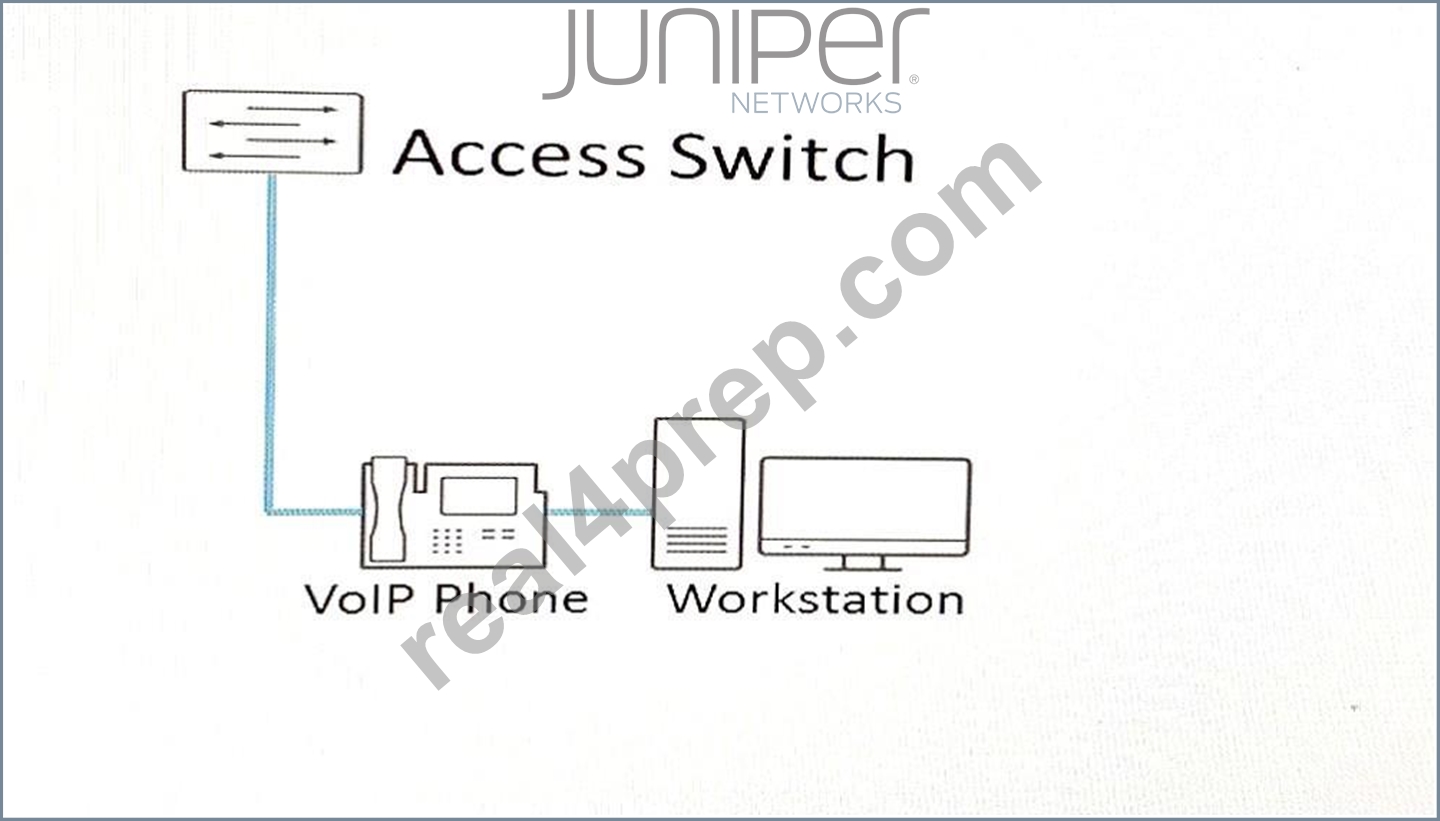
Referring to the exhibit, which statement is true?
- A. MAC bypass must be configured for the VoIP phone for this solution to work.
- B. The VoIP phone will be able to communicate over the network after the workstation authenticates.
- C. The VoIP phone will not be able to communicate over the network.
- D. Authentication must be changed to multiple supplicant mode for this solution to work.
Answer: B
NEW QUESTION # 107
Click the Exhibit.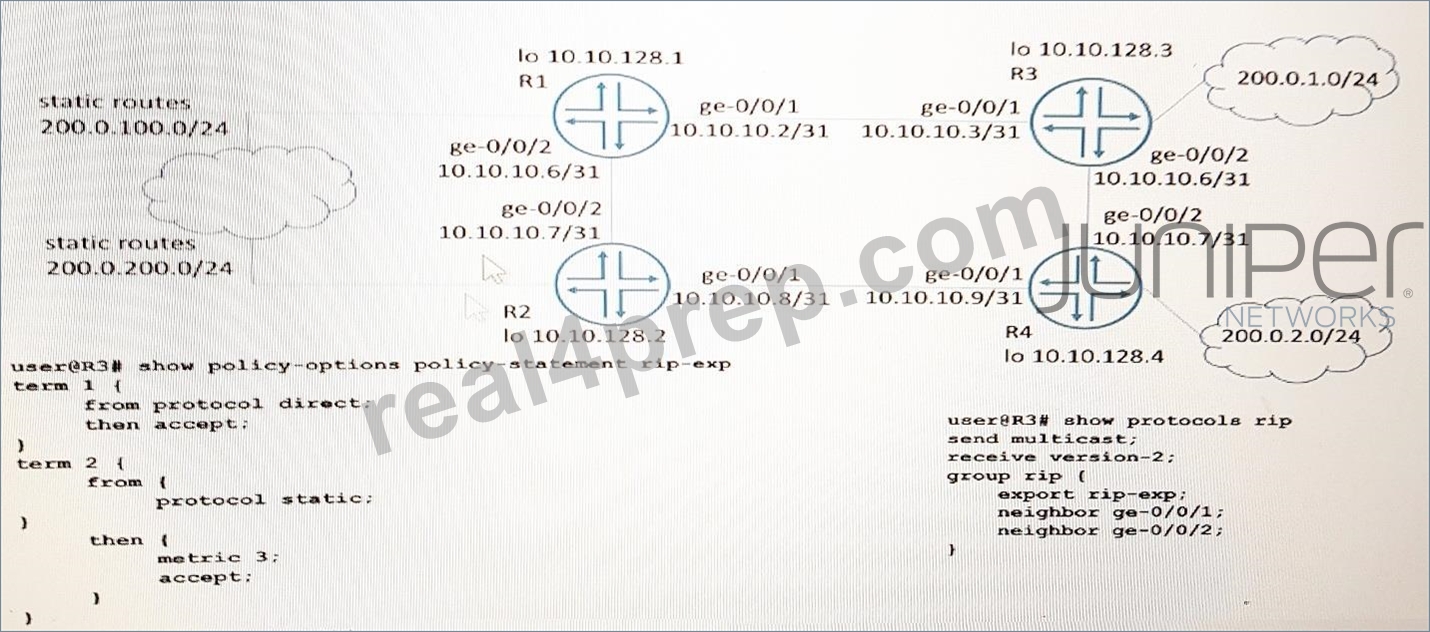
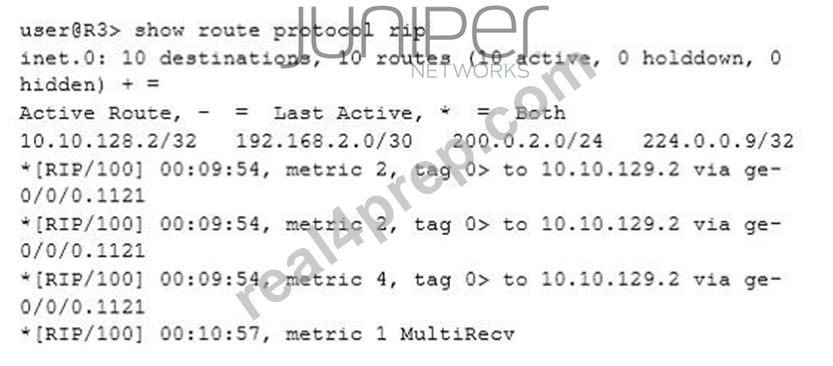
The ping command shows that connectivity of the 200.0.1/24 network to the 200.0.200.0/24 network exists. You notice that all the ping test results from various devices on 200.0.1.0/24 follow the same path even through equal cost paths exist to the 200.0.200.0/24 network.
Referring to the exhibit, what is happening?
- A. RIPv2 does not support load balancing static routes.
- B. The rip-exp policy needs to be modified to advertise RIP routes
- C. The RIP group must include the preference statement.
- D. Load balancing needs to be enabled for equal cost pathing to work.
Answer: D
NEW QUESTION # 108
You are asked to establish interface level authentication for users connecting to your network. You must ensure that only corporate devices, identified by MAC addresses, are allowed to connect and authenticate.
Authentication must be handled by a centralized server to increase scalability.
Which authentication method would satisfy this requirement?
- A. MAC RADIUS
- B. 802.1X with single-secure supplicant mode
- C. 802.1X with multiple supplicant mode
- D. captive portal
Answer: A
Explanation:
* Step 1: Identify the requirements for interface-level authentication.
* Ensure only corporate devices can connect using their MAC addresses.
* Centralized server handles authentication.
* Step 2: Evaluate authentication methods.
* MAC RADIUS: Uses MAC addresses for authentication via a centralized RADIUS server.
* Captive Portal: Typically used for guest access, not suitable for restricting to corporate devices.
* 802.1X with single-secure supplicant mode: Ensures only one device per port, but requires certificates or credentials, not just MAC addresses.
* 802.1X with multiple supplicant mode: Allows multiple devices per port, still requires certificates or credentials.
* Step 3: Select the appropriate method.
* MAC RADIUS: Satisfies the requirement of using MAC addresses for device authentication via a centralized server.
References:
* Juniper authentication configuration and best practices.
* Commands for configuring MAC RADIUS: set protocols dot1x authenticator interface <interface> mac-radius, set access radius-server <server>.
NEW QUESTION # 109
You want to create an OSPF area that only contains intra-area route information in the form of Type 1 and Type 2 LSAs.
In this scenario, which area is needed to accomplish this task?
- A. totally stubby area
- B. stub area
- C. totally non-to-stubby area
- D. non-to-stubby area
Answer: A
Explanation:
A totally stubby area (TSA) is a stub area in which summary link-state advertisement (type 3 LSAs) are not sent. A default summary LSA, with a prefix of 0.0. 0.0/0 is originated into the stub area by an ABR, so that devices in the area can forward all traffic for which a specific route is not known, via ABR.
NEW QUESTION # 110
You are asked to establish full connectivity between all devices in the BGP network.
Referring to the exhibit, which two configuration changes will allow BGP route advertisements? (Choose two.)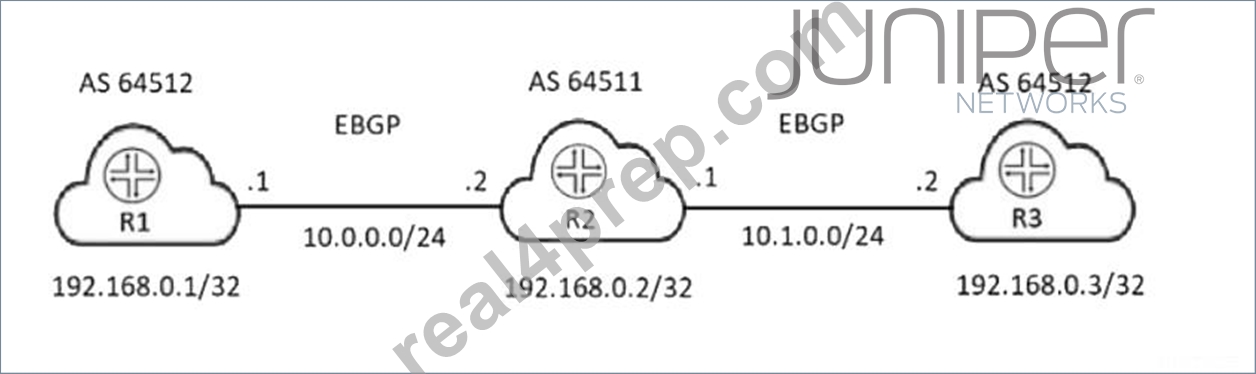
- A. On R1 and R3, include the loops 2 statement at the [edit protocols bgp family inet unicast] hierarchy.
- B. On R1 and R3, include the advertise-peer-as statement at the [edit protocols bgp group external] hierarchy.
- C. On R2, include the loops 2 statement at the [edit protocols bgp family inet unicast] hierarchy.
- D. On R2, include the advertise-peer-as statement at the [edit protocols bgp group external] hierarchy.
Answer: A,D
Explanation:
https://www.juniper.net/documentation/us/en/software/junos/bgp/topics/ref/statement/advertise-peer-as-edit-protocols-bgp.html
NEW QUESTION # 111
Your company has expanded into office space across the street. The new office space has a single Ethernet connection connected to an unmanaged switch. You must sort traffic based on the IP address into different VLANs once the traffic arrives on your EX Series switches.
Which mechanism would you use to accomplish this task?
- A. Q-in-Q tunneling
- B. filter-based VLANs
- C. MVRP
- D. dynamic VLANs
Answer: B
Explanation:
https://next-hop-self.com/juniper-filter-based-vlan-assignment.html
https://www.juniper.net/documentation/us/en/software/junos/routing-
policy/topics/example/firewall-filter-ex-series-configuring.html
NEW QUESTION # 112
Referring to the exhibit, which LSA type is used to advertise 192.168.1.0/24 to R5?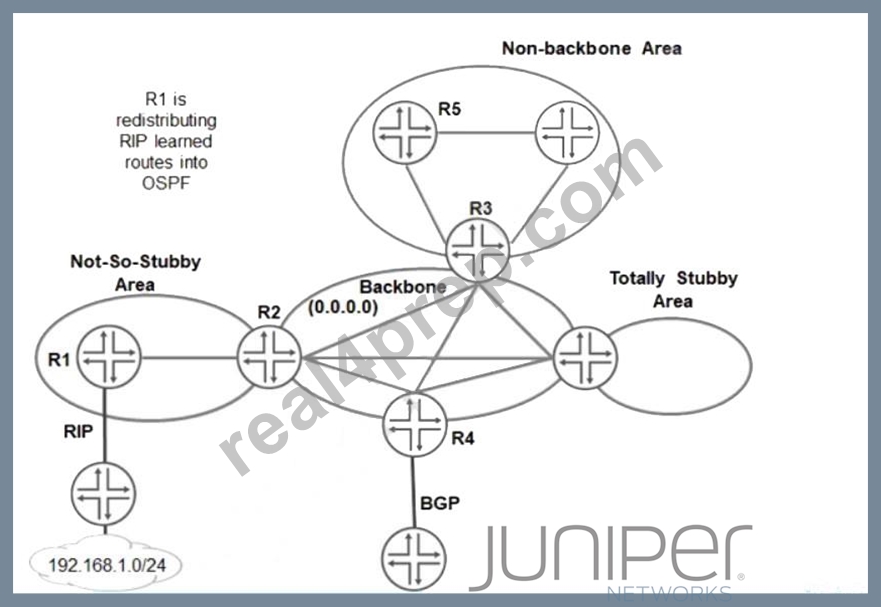
- A. Type 4
- B. Type 3
- C. Type 7
- D. Type 5
Answer: D
Explanation:
Area-1 has no external connections. However, Area-1 has static route (172.16.31.0/24) that are not internal OSPF route. You can limit the external route advertisements to the area and advertise the static routes by designating the area an NSSA. In an NSSA, the ASBR (vMX1) generates NSSA external (Type 7) LSAs and floods them into the NSSA, where they are contained.
Type-7 LSAs allow an NSSA to support the presence of ASBR and their corresponding external routing information. The ABR (vMX2) converts Type-7 LSAs into Type-5 External LSAs and leaks them to the other areas, but external routes from other areas are not advertised within the NSSA.
An admin should check this and change it
https://www.packetswitch.co.uk/configuring-junos-ospf-stub-and-nssa-areas/
https://www.juniper.net/documentation/us/en/software/junos/ospf/topics/ref/statement/nssa-edit-protocols-ospf.html
NEW QUESTION # 113
Referring to the exhibit, which statement is correct?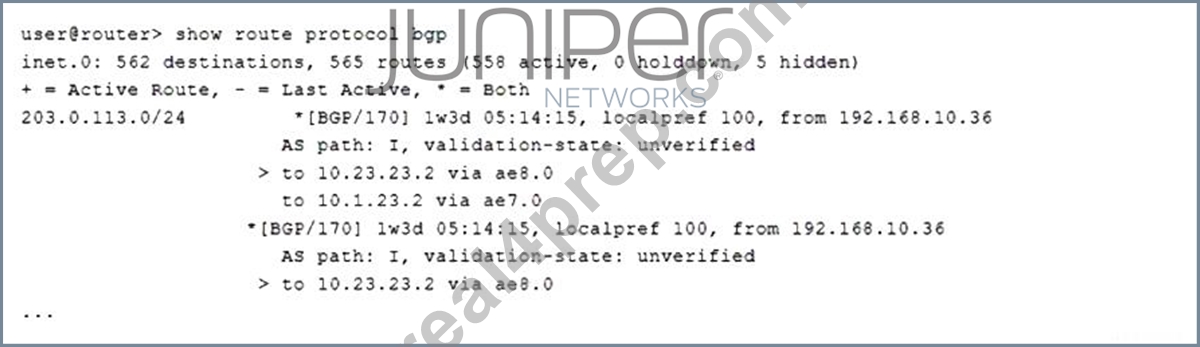
- A. The route is learned from three different neighbors.
- B. The route is learned from only one neighbor.
- C. The route is learned from a multihop BGP session.
- D. The route is learned from a multipath BGP session.
Answer: B
Explanation:
* Analyzing BGP Route Information:
* The exhibit shows BGP route information for the prefix 203.0.113.0/24.
* Both paths to this prefix are learned from the same BGP peer with IP address 192.168.10.36.
* Understanding BGP Neighbors:
* The presence of multiple paths for the same prefix does not necessarily indicate multiple neighbors.
* In this case, the routes to 203.0.113.0/24 are both learned from a single neighbor (192.168.10.36), but via different interfaces (ae8.0 and ae7.0).
* Conclusion:
* The BGP routes in the exhibit indicate that the prefix is learned from one neighbor but via different interfaces.
References:
* BGP route analysis
* Understanding BGP multi-path and neighbor relationships
NEW QUESTION # 114
You are troubleshooting a BGP connection.
Referring to the exhibit, which two statements are correct? (Choose two.)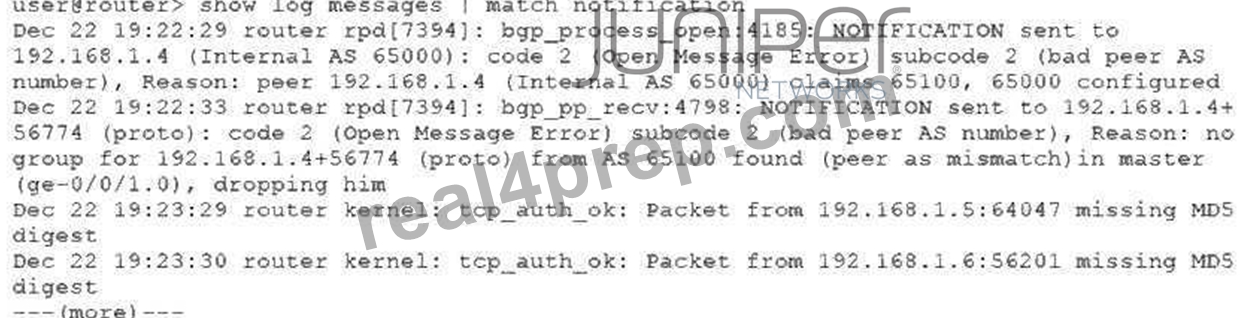
- A. Packet fragmentation is preventing the session from establishing.
- B. The 192.168.1.5 peer has a misconfigured MD5 key.
- C. The ge-0/0/1 interface is disabled.
- D. The 192.168.1.4 peer has a misconfigured autonomous system number.
Answer: A,C
NEW QUESTION # 115
What are two OSPF LSA types? (Choose two.)
- A. Router
- B. Stub
- C. Network
- D. Transit
Answer: A,C
NEW QUESTION # 116
What information must you gather from the satellite device to provision a Junos Fusion Enterprise deployment on the aggregation device? (Choose two.)
- A. Model number
- B. Serial number
- C. Software version
- D. MAC address
Answer: B,D
NEW QUESTION # 117
You are deploying an 802.1X solution and must determine what would happen if clients are unable to re-authenticate to the RADIUS server.
In this scenario, which configuration would provide access to the network if the supplicant is already authenticated?
- A. deny
- B. sustain
- C. move
- D. permit
Answer: D
Explanation:
* 802.1X Authentication and Re-authentication:
* 802.1X is used for network access control, where clients (supplicants) authenticate through a RADIUS server.
* If a client cannot re-authenticate, the network access behavior depends on the configured action.
* Permit Access Configuration:
* The permit action ensures that the client continues to have network access if re-authentication fails.
* This is crucial in scenarios where continuous access is needed despite temporary authentication issues.
* Configuration Syntax:
* On the Juniper device, configure the permit action:
plaintext
Copy code
set protocols dot1x authenticator authentication-profile <profile> re-authentication permit References:
* Juniper documentation on 802.1X configuration
* Understanding 802.1X re-authentication and access control mechanisms
NEW QUESTION # 118
Click the Exhibit.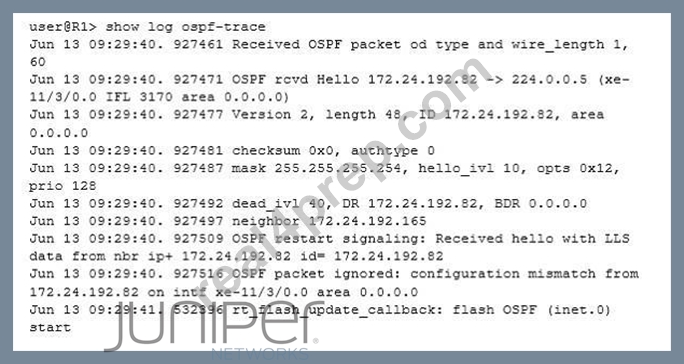
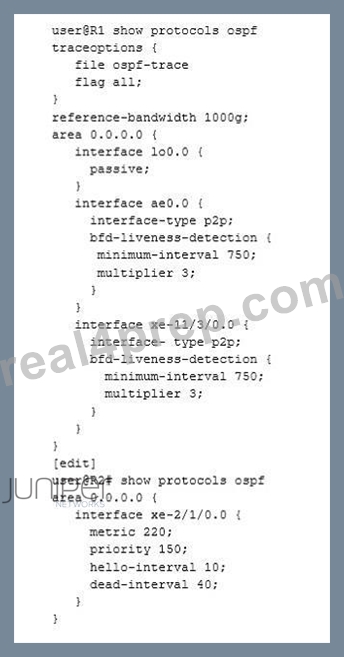
You have just configured on an OSPF adjacency between two routers. After you commit the configuration, you notice that your adjacency is not up.
Referring to the exhibit, what would cause the problem?
- A. You must configure hello and dead intervals on R1.
- B. You must configure lo on R2.
- C. You must configure bfd on R2.
- D. You must configure on interface-type o n R2.
Answer: D
NEW QUESTION # 119
You are troubleshooting connectivity between an EVPN spine switch configured as a route reflector and a leaf node with an IP address of 10.30.100.6.
Referring to the exhibit, what is the problem?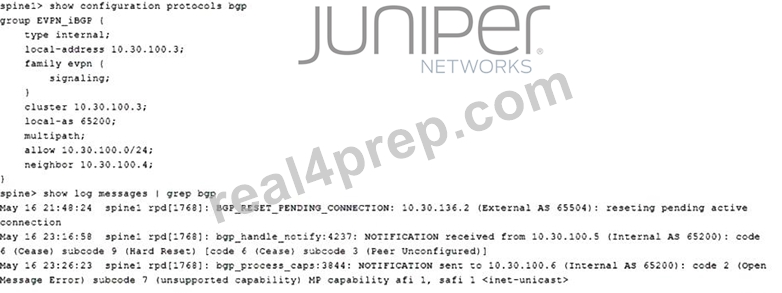
- A. The neighbor 10.30.100.3 statement is missing from leaf1's configuration.
- B. The leaf node is not configured for the family evpn NLRI.
- C. The neighbor 10.30.100.6 statement is missing from spine1's configuration.
- D. The spine node is not configured for the family inet NLRI.
Answer: B
Explanation:
* The leaf node is not configured for the family evpn NLRI (D):
* The exhibit shows that there is an unsupported capability NP error for AFI 1, SAFI 70. This indicates that the leaf node is not configured to support the EVPN (Ethernet VPN) address family.
References:
* The BGP configuration and troubleshooting details can be found in "Juniper Commands.pdf" and related EVPN configuration documents.
NEW QUESTION # 120
......
Master 2025 Latest The Questions JNCIP-ENT and Pass JN0-649 Real Exam!: https://www.real4prep.com/JN0-649-exam.html
A fully updated 2025 JN0-649 Exam Dumps exam guide from training expert Real4Prep: https://drive.google.com/open?id=1UPKBs8s2jFBfPdn0HxeJTuc3yhtRZQFK