


2026 Latest MB-280 DUMPS Q&As with Explanations Verified & Correct Answers
MB-280 dumps Exam Material with 150 Questions
NEW QUESTION # 16
Note: This question is part of a series of questions that present the same scenario. Each question in the series contains a unique solution. Determine whether the solution meets the stated goals. Some question sets might have more than one correct solution, while others might not have a correct solution.
After you answer a question in this section, you will NOT be able to return to it. As a result, these questions will not appear in the review screen.
You configure forecasts for a clothing manufacturer.
A salesperson updates an opportunity and wants to refresh the forecast
You need to show the salesperson how to refresh the forecast.
Solution: Update the roll-up recurrence frequency.
Does this meet the goal?
- A. Yes
- B. No
Answer: B
Explanation:
https://learn.microsoft.com/en-us/dynamics365/sales/keep-forecast-data-up-to-date
https://learn.microsoft.com/en-us/dynamics365/sales/forecast-recalculation-methods
NEW QUESTION # 17
Note: This question is part of a series of questions that present the same scenario. Each question in the series contains a unique solution. Determine whether the solution meets the stated goals. Some question sets might have more than one correct solution, while others might not have a correct solution.
After you answer a question in this section, you will NOT be able to return to it. As a result, these questions will not appear in the review screen.
You configure forecasts for a clothing manufacturer.
A salesperson updates an opportunity and wants to refresh the forecast
You need to show the salesperson how to refresh the forecast.
Solution: Recalculate the opportunity.
Does this meet the goal?
- A. Yes
- B. No
Answer: B
Explanation:
Correct:
* Recalculate the forecast
Incorrect:
* Recalculate the opportunity.
* Update the Opportunity Forecast Category Mapping process.
Note:
Example of forecast recalculation methods
Let's understand the different methods with an example. Consider a scenario where you have a forecast with 4 quarterly periods and an annual period. Assume that you're currently in Q4. The following table shows when and how the forecast data is updated for different scenarios and periods.
--
Dynamics 365 Sales, Recalculate forecasts manually
You want the forecast data to be up-to-date to make informed decisions. Forecast data is automatically recalculated at regular intervals. However, you can trigger a manual recalculation when you want to recalculate the forecast data immediately. You can also trigger a manual recalculation for past and future periods as they aren't automatically recalculated.
Recalculate and refresh forecast data manually
1. Open the forecast. Verify the Last updated timestamp on the command bar to know when the forecast was last recalculated successfully.
2. Select Recalculate data.
A notification appears at the top of the screen, confirming the recalculation. Recalculation happens in the background, and you can continue to work while recalculation is in progress.
3. After the application recalculates the forecast data, a notification appears to refresh the data. On the notification, select Refresh page.
Reference:
https://learn.microsoft.com/en-us/dynamics365/sales/keep-forecast-data-up-to-date
https://learn.microsoft.com/en-us/dynamics365/sales/forecast-recalculation-methods
NEW QUESTION # 18
You are a marketing automation consultant.
Your customer wants to understand the benefits of using the query assist feature in Dynamics 365 Customer Insights - Journeys. Why might your customer want to use this feature?
- A. When looking at a segment created by another user, the natural language feature makes it easier to identify which journeys the segment is used in.
- B. Using the natural language feature allows marketers to search Dataverse to retrieve single records using a right-hand pane on the model-driven app
- C. When looking at a marketing journey created by another user, the natural language feature makes it easier to understand the logic of the journey and decide whether it meets the campaign goals.
- D. Using the natural language feature allows marketers to build segments using simple words to specify what audience they want to target.
Answer: D
Explanation:
* The Query Assist feature in Dynamics 365 Customer Insights - Journeys utilizes natural language processing to help marketers easily build segments.
* By using simple language, marketers can describe their target audience without needing to know complex query syntax, making segmentation more accessible.
* This feature is designed to streamline segment creation, allowing marketers to quickly define their audience with natural language inputs, which is particularly useful for users who may not be familiar with technical query building.
NEW QUESTION # 19
Note: This question is part of a series of questions that present the same scenario. Each question in the series contains a unique solution that might meet the stated goals. Some question sets might have more than one correct solution, while others might not have a correct solution.
After you answer a question in this section, you will NOT be able to return to it. As a result, these questions will not appear in the review screen.
You use business process flows for all Dynamics 365 opportunities.
Some opportunities are closed before business process flow durations are calculated.
You need to ensure that business process flow duration values are calculated.
Solution: Change the opportunity to an inactive state.
Does this meet the goal?
- A. Yes
- B. No
Answer: B
Explanation:
Changing an opportunity to an inactive state does not trigger the calculation of business process flow duration values. The business process flow duration is calculated based on the active duration of the business process flow stages while the opportunity is active.
NEW QUESTION # 20
An organization is using Microsoft Power Query when connecting to data sources in Dynamics 365 Customer Insights - Data.
You need to load contacts to Customer Insights - Data using Power Query.
Which is an appropriate action to take when using Power Query to ingest data?
- A. You must select Power Query as an import method when creating the data source.
- B. You can only add additional columns to the dataset in Power Query before the data source is created in Customer Insights - Data.
- C. You must create a separate Power Query data source for each table you wish to ingest.
- D. After you save a Power Query data source, you have to manually trigger the initial refresh process.
Answer: D
Explanation:
Correct:
* After you save a Power Query data source, you have to manually trigger the initial refresh process.
* You can add additional tables to the data source using Get Data functionality in the Power Query.
Incorrect:
* After you save a Power Query data source, you have to manually trigger the initial refresh process.
* You can only add additional columns to the dataset in Power Query before the data source is created in Customer Insights - Data.
* You must create a separate Power Query data source for each table you wish to ingest.
Note:
* After you save a Power Query data source, you have to manually trigger the initial refresh process.
For Power BI users, refreshing data typically means importing data from the original data sources into a semantic model, either based on a refresh schedule or on demand. You can perform multiple semantic model refreshes daily, which might be necessary if the underlying source data changes frequently.
* You can add additional tables to the data source using Get Data functionality in the Power Query.
When using Power Query in Dynamics 365 Customer Insights - Data, you have the flexibility to add additional tables to your data source through the Get Data functionality. This allows you to manage multiple tables and sources efficiently within a single Power Query environment.
Reference:
https://learn.microsoft.com/en-us/power-bi/connect-data/refresh-data
NEW QUESTION # 21
You are the Dynamics 365 administrator at an organization that uses both Dynamics 365 Customer Insights - Journeys and Dynamics 365 Sales.
You have configured Customer Insights - Journeys to create leads from web form submissions. You also allow your sales users to create leads using the user interface.
Your organization has recently hosted an event at a conference.
* You have a Customer Insights - Journeys web form to capture leads immediately at the conference.
* You expect sales users to enter lead information for prospects they meet at the event in the week after the conference.
You need to keep your data clean while also capturing all the valid leads from the event. What should you do?
- A. Go to The settings area in Customer Insights - Journeys and ensure the default form matching strategy is selected.
- B. Go to the classic editor and remove Create permissions from the security group for sales users.
- C. Go to business management settings and enable duplicate detection on leads based on email.
- D. Go to the form in Customer Insights - Journeys and update the form so that it can either create new leads or update existing leads.
Answer: C
Explanation:
Requirement Analysis:
The organization is collecting lead data from two sources: a web form created in Customer Insights - Journeys and manual entries by sales users. This setup could lead to duplicate entries if a lead is submitted through the web form and then entered manually by a sales user afterward.
To ensure data integrity and avoid duplication, it is essential to implement a mechanism that identifies and manages duplicates automatically.
Solution - Enabling Duplicate Detection:
In Dynamics 365, duplicate detection can be configured to alert users or prevent the creation of records that already exist based on certain criteria (such as email).
By enabling duplicate detection based on email addresses, the system will compare incoming lead data with existing records and prompt users if a duplicate is identified. This feature will ensure that leads collected from different sources are not duplicated unnecessarily.
Steps to Enable Duplicate Detection for Leads Based on Email:
Navigate to Settings > Data Management > Duplicate Detection Rules in Dynamics 365.
Create a new Duplicate Detection Rule for the Lead entity. Specify that the system should check for duplicate records based on the email field.
Publish the rule and ensure it is activated.
After activation, this rule will prompt users whenever a duplicate email is detected, either from the Customer Insights - Journeys web form or manual entry by sales users.
Reference:
Benefits of Using Duplicate Detection:
This approach does not restrict users from creating leads but ensures that duplicate entries are flagged, allowing users to review and decide whether to proceed.
It maintains data cleanliness by preventing unnecessary duplicates while ensuring all valid leads are captured from different sources.
By implementing this solution, the organization can effectively manage potential duplicate leads, keeping the data clean and accurate across both Customer Insights - Journeys and Dynamics 365 Sales.
NEW QUESTION # 22
You are a Dynamics 365 Sales system customizer.
Salespeople report that they cannot search for open and closed opportunities using the search tool in the Quick Find View.
You need to configure the search tool to show the open and closed opportunities in the Customize the System area.
Which three actions should you perform in sequence? To answer, move the three appropriate actions from the list of actions to the answer are a. Arrange the three actions in the correct order.
Answer:
Explanation:
NEW QUESTION # 23
Note: This question is part of a series of questions that present the same scenario. Each question in the series contains a unique solution that might meet the stated goals. Some question sets might have more than one correct solution, while others might not have a correct solution.
After you answer a question in this section, you will NOT be able to return to it. As a result, these questions will not appear in the review screen.
A company's IT department has a .CSV file stored on one of their Shared Documents folders within their Microsoft SharePoint sites. The data from the .CSV file is ingested into Dynamics 365 Customer Insights - Data.
The file contains a row header and columns of different types, such as quantities and prices. The file also contains some rows with a high proportion of nulls.
You need to clean and transform the data in Customer Insights - Data to be ready for unification.
Solution: Transform the first row to be used as headers. Define column types to be the appropriate field types and name the query. Create a full name and full address columns by merging the appropriate columns if they exist. Select Next and your data is now ready for unification.
Does this meet the goal?
- A. No
- B. Yes
Answer: B
Explanation:
The proposed solution effectively prepares the data for unification in Dynamics 365 Customer Insights - Data. Here's how each step contributes to meeting the goal:
Transform the first row to be used as headers: This step is necessary to define the column names, which is critical for accurate data interpretation.
Define column types to be the appropriate field types: Specifying the correct data types for each column ensures that the data will be processed correctly during unification, maintaining data integrity.
Create a full name and full address columns by merging the appropriate columns if they exist:
This step enhances the dataset by consolidating relevant information into single columns, which can simplify data usage and improve data quality. Merging columns helps ensure that users can easily access essential information without navigating through multiple fields.
Select Next: This indicates that the data transformation steps are completed and the dataset is ready for the unification process.
NEW QUESTION # 24
A marketing user wants to target two groups of customers:
1. All customers that live in Paris.
2. All customers that have made more than ten online purchases.
You decide to meet this requirement by making quick segments.
Which two options should you use as the base in the quick segments? Each correct answer presents part of the solution. (Choose two.) NOTE: Each correct selection is worth one point.
- A. Insights
- B. Data tables
- C. Profiles
- D. Enrichments
- E. Measures
Answer: C,E
Explanation:
* All customers that live in Paris.
Customer profile data has address information.
* All customers that have made more than ten online purchases.
Incorrect:
Not Data tables [Not available for Quick Segments]
Not Enrichments [Not available for Quick Segments]
Note:
Quick segments let you build simple segments with a single operator quickly for faster insights. Quick segments are only supported in environments for individual customers.
Create a new segment with quick segments
1. Go to Insights > Segments.
2. Select New > Create from.
Select the Profiles option to build a segment that is based on the unified customer table.
Select the Measures option to build a segment around measures you have previously created.
Select the Insights option to build a segment around one of the output tables you generated using either the Predictions or Custom Models capabilities.
3. In the New quick segment dialog box, select an attribute from the Field dropdown.
Etc.
Reference:
https://learn.microsoft.com/en-us/dynamics365/customer-insights/data/enrichment-hub
https://learn.microsoft.com/en-us/dynamics365/customer-insights/data/segment-quick
NEW QUESTION # 25
Drag and Drop Question
In your organization, Dynamics 365 Customer Insights - Data contains information about online purchases made by customers, sourced from a table ingested from your e-commerce platform.
This information is useful to your sellers because they want to gain a complete understanding of all purchases made by their customers, and not just purchases managed using Dynamics 365 Sales Opportunity records.
You need to make these online purchases visible to sellers in the timeline of the Contact records in Dynamics 365 Sales.
Which three actions should you perform in sequence? To answer, move the three appropriate actions from the list of actions to the answer area. Arrange the three actions in the correct order.
Answer:
Explanation:
Explanation:
Reference:
https://learn.microsoft.com/en-us/dynamics365/customer-insights/data/activities-in-d365-timeline
https://learn.microsoft.com/en-us/power-apps/maker/model-driven-apps/custom-connectors- timeline-control
NEW QUESTION # 26
Case Study 2 - Terra Flora
Background information
Terra Flora, Incorporated is a boutique pet hotel that has been in business for six (6) months. The hotel guests include both dogs and cats.
The founder created the Dynamics 365 Sales Professional environment to grow their network and pipeline. They started out using out-of-the-box capabilities only and using the Sales Professional app only. Only one environment (production) is in use.
The pet hotel is gaining in popularity and the number of bookings is growing. The founder has shifted their focus to customizing their environment to record the information they need to delight their customers by tailoring the experience to their unique pets.
Terra Flora has recently hired a part-time carer for the resident pets. The carer has been granted the Salesperson security role to allow them to record new leads and update customer information.
You are a Dynamics 365 Customer Experience consultant who has been hired to assist Terra Flora with their customizations, resolve issues, and advise on best designs to meet their requirements.
Configurations
Overall configurations
To better understand their four-legged customers, Terra Flora has created a custom Pet table, which is user-owned and related 1-n with the Contact table, which represents the pets' primary owner.
The Pet table has been added to the Sales Professional app sitemap. The table has the following columns, each created WITHOUT making any changes to the advanced options.
A pet sub-grid has been added to the Contact main form, using the Active Pets view.
Additionally, Read, Write, and Update, Append, Append To, and Assign access to the Pet table has been added to the Salesperson security role.
"Onboard new pet" business process flow
The founder is creating a business process flow named Onboard new pet to ensure that appropriate information is recorded for all new pets, starting with ensuring the correct litter choices are selected for cats who will be staying at Terra Flora.
When the Onboard new pet business process flow is done, the founder wants to have access to a view that will display all active pets including the and Type columns, as well as the current stage on the Onboard new pet business process flow.
Name
Pet table icon
A custom image .svg file has been created for the Pet table.
Terra Flora wants to ensure this image is displayed alongside the pet page within the app.
Related Pet table activities
Terra Flora wants carers to be able to see their pets' activity history, as well as add new activities related to their pets. They want the following information to appear on their pets' timeline:
- Tasks carers completed or should do.
- E-mails exchanged with pet's owner (customer).
- A record of phone calls.
Other types of activities should NOT appear to users on the Pets forms.
The founder edited the Pet table advanced setting to enable associating Pet records with activities. The founder also added Pet table to the app sitemap that is being used.
Attachments are enabled for the Pet table, including notes and files. But users should NOT see posts in the pet's activity timeline.
Post configuration is NOT enabled for the Pet table.
Logs
Auditing, log access, and read logs have been enabled in the production environment.
Auditing has started on the Terra Flora environment and has been enabled for common entities.
Marketing
Breed galas
To celebrate their upcoming first year in operation, the founder is planning a series of breed galas. The series begins with a Corgi dog breed meet-up gala.
The breed of an owner's pet may be mentioned in many places within the system, including:
1. Emails (subject or body).
2. Notes (including Word documents exports of PDFs uploaded as attachments).
3. Single or multiple lines of text columns on any standard table (including lead, contact and opportunity at minimum).
4. On the Pet table in either the Description or in the Breed columns.
Additionally, the breed may be referenced in several ways including singular, multiple, shorthand (for example: corgi, corgis, or corgs), and may have been misspelled.
Corgi meet-up gala
The carer needs to be assigned ownership of several Contact records (representing customers that own Corgis) that live nearby so that event flyers can be delivered personally. When the carer is delivering flyers, they need to quickly check the owner and related pet information on their phone.
When the Contact records are assigned to carer, any pets that are related to these contacts via the primary owner relationship should also be assigned to the carer.
The founder has created a business process flow on the Pet table named Corgi meet-up to allow Corgis to be registered as attending the gala. This business process flow is second in the default order on the Pet table. If the carer has a conversation with the owners, the carer is required to add notes to the timeline and complete the first stage of the business process flow.
Issues
Duplicate records
Before the creation of the Pet table, information regarding pets was either added to the owner's Contact record in the form of notes or created as records themselves.
Contact
These Contact records used the name of the pet in the Last Name column and the owner's address in the first set of Address columns.
When these pet Contact records are identified, they are deactivated.
No duplicate detection rules have been published and duplicate pet records are currently present across both the Contact and Pet tables.
Auditing
When a pet's dietary requirements or a Contact's email address is updated, Terra Flora requires the following information to be logged:
1. The user who made the change.
2. The current and previous values of the columns.
3. The time and date of the changes.
Terra Flora also needs to track any exports of records to Microsoft Excel within the compliance center.
Relationship behavior
Recently, a pet owner informed Terra Flora that their pet cat has been rehomed.
After receiving this information, the carer deleted the owner's Contact record from the system, which in turn deleted the Pet record.
Shortly after, the new pet owner contacted Terra Flora to book their cat for a stay and was frustrated that Terra Flora had NOT retained a record of their cat's dietary requirements or any of the previous carer notes about the cat.
In such situations, Terra Flora now requires that the owner's Contact record should NOT be allowed to be deleted if any Pet records are related to it via the primary owner look-up column.
Users should be required to update the look-up column to new owner's Contact record or remove the current value first before they can delete the Pet record. If the new owner's Contact record is selected on a pet, any active bookings against the pet should also be updated to the new owner, but previous inactive bookings should NOT be updated.
Business process flows and the Corgi meet-up gala
The founder has recently made an update to the Onboard new pet business flow but now CANNOT activate it.
For the Corgi gala, the founder has asked the carer for help in:
1. completing the registrations that the founder started, and
2. registering more Corgis for the upcoming gala.
When the carer creates new pet records, the carer is UNABLE to see the Corgi meet-up business process flow.
Currently, when the carer checks the owner's record on their phone, the related pet information is difficult to view as they must scroll down to review the information.
Hotspot Question
You are creating a business process flow named "Onboard new pet" to support onboarding of new clients for a pet care business.
A partially completed business process flow is shown in the following exhibit.
Use the drop-down menus to select the answer choice that completes each statement based on the information presented in the exhibit.
NOTE: Each correct selection is worth one point.
Answer:
Explanation:
Explanation:
To enable the business process flow to pass validation, you should ensure that - The false side of the condition is connected to a stage. A business process flow (BPF) must have all possible outcomes leading to a valid stage. In the given BPF, only the true condition (if the pet is a cat) is leading to a stage. However, the false condition (for dogs and birds) must also be connected to a stage to avoid validation errors.
After the flow has been updated to pass validation, when a user starts creating a new pet record, the user will see - Two stages The process starts with the Basic Details stage. If the pet is a cat, it moves to the Litter Type stage. If the pet is not a cat, the process would still need to continue but may follow a different path. Since only two stages are visible in the design, the user will see two stages.
NEW QUESTION # 27
Note: This question is part of a series of questions that present the same scenario. Each question in the series contains a unique solution. Determine whether the solution meets the stated goals. Some question sets might have more than one correct solution, while others might not have a correct solution.
After you answer a question in this section, you will NOT be able to return to it. As a result, these questions will not appear in the review screen.
You configure forecasts for a clothing manufacturer.
A salesperson updates an opportunity and wants to refresh the forecast
You need to show the salesperson how to refresh the forecast.
Solution: Recalculate the opportunity.
Does this meet the goal?
- A. Yes
- B. No
Answer: B
Explanation:
Correct:
* Recalculate the forecast
Incorrect:
* Recalculate the opportunity.
* Update the Opportunity Forecast Category Mapping process.
Note:
Example of forecast recalculation methods
Let's understand the different methods with an example. Consider a scenario where you have a forecast with 4 quarterly periods and an annual period.
Assume that you're currently in Q4. The following table shows when and how the forecast data is updated for different scenarios and periods.
--
Dynamics 365 Sales, Recalculate forecasts manually
You want the forecast data to be up-to-date to make informed decisions. Forecast data is automatically recalculated at regular intervals. However, you can trigger a manual recalculation when you want to recalculate the forecast data immediately. You can also trigger a manual recalculation for past and future periods as they aren't automatically recalculated.
Recalculate and refresh forecast data manually
1. Open the forecast. Verify the Last updated timestamp on the command bar to know when the forecast was last recalculated successfully.
2. Select Recalculate data.
A notification appears at the top of the screen, confirming the recalculation. Recalculation happens in the background, and you can continue to work while recalculation is in progress.
3. After the application recalculates the forecast data, a notification appears to refresh the data.
On the notification, select Refresh page.
NEW QUESTION # 28
A company manufactures widgets. Widgets can be sold in the following ways:
The company discovers that customers want to buy widgets individually.
You need to add a unit named Each.
What should you do?
- A. Create the unit Each with Box as the base unit.
- B. Set Each as the primary unit.
- C. Make Each the base unit for all units.
- D. Update the unit Box with Each as the base unit
Answer: C
Explanation:
In Dynamics 365 Sales, unit groups define how products are sold in different quantities. The base unit is the smallest unit of measure in a unit group.
Since customers now want to buy widgets individually, the smallest unit (Each) should be set as the base unit for all other units (Box, Case, and Pallet).
NEW QUESTION # 29
You are creating a forecast. You want to include only opportunities that sell You need to configure this within the system. What should you configure?
- A. additional filters
- B. multiple columns
- C. advanced features
- D. separate views
- E. premium forecasting
Answer: A
Explanation:
Requirement Analysis:
The goal is to include only specific opportunities-those that "sell"-in the forecast. This requires the ability to selectively include opportunities that meet specific criteria, such as the status, stage, or type of sale.
Solution - Using Additional Filters:
In Dynamics 365 Sales, additional filters can be applied within the forecast configuration to refine the opportunities included. Filters allow you to specify criteria such as opportunity status, probability, estimated revenue, or any custom field that signifies the opportunity has "sold." By setting up filters, you can ensure that only opportunities matching the desired criteria are included in the forecast, providing a targeted and accurate view of expected sales.
Steps to Configure Additional Filters in Forecasting:
Go to Sales > Forecasts, and select or create a new forecast.
In the forecast settings, navigate to Filters and add conditions that define which opportunities are included. For example, you can filter based on status (e.g., only include opportunities marked as "Won").
Save and apply the filter settings to ensure only the relevant opportunities appear in the forecast.
Reference:
Benefits of Using Filters:
Filters provide flexibility to customize the forecast view, allowing for detailed segmentation of opportunities based on specific conditions.
This approach ensures that the forecast reflects only the opportunities that are relevant to your defined criteria, which in this case is opportunities that have "sold." By using additional filters, you can effectively control which opportunities are included in your forecast, aligning it with specific business needs and improving forecast accuracy.
NEW QUESTION # 30
You are creating a pricing list in Dynamics 365 Sales. All prices must end in $.98.
You need to select the function that establishes this pricing requirement.
What should you use?
- A. Rounding Policy
- B. Rounding Amount
- C. Pricing Method
- D. Percentage
Answer: A
Explanation:
In Dynamics 365 Sales, to ensure that all prices end in a specific format, such as $.98, you should use the Rounding Policy. This function allows you to define how prices should be rounded, including the ability to specify that they should end in particular digits. By setting a rounding policy, you can enforce this pricing requirement consistently across your pricing lists.
NEW QUESTION # 31
Hotspot Question
A company generates leads from a webform. Salespeople manage leads by country/region. All salespeople are part of the same Dynamics 365 Sales team.
The sales manager requires the following functionality:
- Automate lead assignments.
- Ensure each seller can never have more than 20 open leads.
You create a country/region attribute for the process. You must simplify the process. You plan to use segments when possible.
You need to create a lead assignment rule for each country/region.
Which configurations should you use? To answer, select the appropriate options in the answer area.
NOTE: Each correct selection is worth one point.
Answer:
Explanation:
Explanation:
Filter leads for assignment Create a segment to filter the lead source and country/region. Since the company wants to automate lead assignments and use segments, filtering by both lead source and country/region ensures the most refined and effective lead segmentation for assignment.
Assign the country/region to the correct group Assign the country/region to specific sellers.
Since leads must be assigned based on country/region, assigning them to specific sellers ensures that each salesperson is responsible for leads in their designated region.
Distribute leads to salespeople Use load balancing.
Load balancing ensures that each seller never has more than 20 open leads by evenly distributing leads among salespeople, preventing overload and optimizing workload distribution.
NEW QUESTION # 32
You are a Dynamics 365 Sales administrator. You create a forecast by using the forecast category layout shown in the exhibit: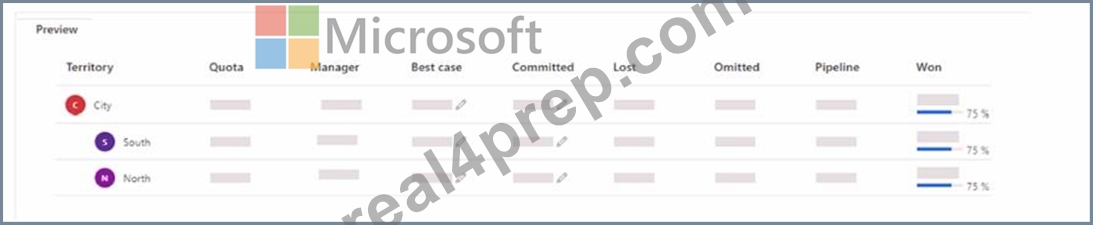
Use the drop-down menus to select the answer choice that answers each question based on the information presented in the graphic.
NOTE: Each correct selection is worth one point.
Answer:
Explanation:
Reference:
Deleting the Lost Column from the Forecast:
To remove a column entirely, such as the Lost column, you should adjust the Forecast configuration. This configuration setting allows you to add or remove columns from the forecast grid.
Modifying Forecast configuration affects the structural aspects of the forecast, such as which columns are included, based on what is necessary for reporting and analysis.
By utilizing the Layout column settings for renaming columns and the Forecast configuration for adding or removing columns, you can tailor the forecast layout to meet specific business requirements, ensuring the forecast view is both relevant and easy for users to interpret.
NEW QUESTION # 33
Drag and Drop Question
Your organization introduced a new loyalty solution that exposes the loyalty profile and related point transactions in an Azure SQL Database.
You need to ensure the new loyalty data is imported from the Azure SQL Database into Dynamics 365 Customer Insights ?Data and refreshed incrementally.
Which five actions should you perform in sequence within Customer Insights ?Data before selecting Save to complete the creation? To answer, move the five appropriate actions from the list of actions to the answer area. Arrange the five actions in the correct order.
Answer:
Explanation:
Explanation:
Step 1: Create a new data source based on Microsoft Power Query
To configure Dynamics 365 Customer Insights - Data, first bring in source data for processing.
Customer Insights - Data provides several types of data connectors to connect to and ingest data from a broad set of sources.
Customer Insights - Data, Connect to a Power Query data source
Power Query with data source Azure SQL Database supports incremental refresh.
Step 2: Select the data source and tables to ingest
Connect to Azure SQL database from Power Query Desktop
To connect to an Azure SQL database from Power Query Desktop, take the following steps:
1. Select Azure SQL database in the get data experience. The get data experience in Power Query Desktop varies between apps
2. In SQL Server database, provide the name of the server and database (optional).
3. Select either the Import or DirectQuery data connectivity mode.
[Steps omitted]
7. In Navigator, select the database information you want [Step 2], then either select Load to load the data or Transform Data [Step 3] to continue transforming the data in Power Query Editor.
Step 3: Complete the transformation steps and select Next,
Step 4: In the Set up incremental refresh dialog box, select Set up to open the Incremental refresh settings.
When you select Incremental Refresh [Step 4], a pop-up window will appear. In this window, select the table [Step 5] that you want to set up for incremental refresh and click the button next to Incrementally refresh this table.
Step 5: Select the tables and provide the required incremental refresh details.
NEW QUESTION # 34
You are using a forecast template.
You must configure the forecast by territory.
You need to configure the forecast parameters.
Which parameter should you configure?
- A. Rollup table
- B. Top of hierarchy
- C. Hierarchy relationship
- D. Hierarchy table
Answer: C
Explanation:
Define a forecast model
Define the entities that must be used to generate the forecast.
1. In the General step of the Forecast configuration page, define the fields that should be used for the forecast.
[Steps 2 to 6 omitted]
7. Select a Rollup to hierarchy relationship.
This step establishes a relationship between the rollup and hierarchy entities. Each forecast template starts with a default rollup to hierarchy relationship:
Choose different values to support your organization's specific requirements if needed.
Note: Select a template
The fastest way to create a forecast is to use a template. The template that you select defines how the forecast groups data.
On the Forecast configurations page, select one of the following templates:
Org chart forecast: Rollup columns and projections are based on your organization's reporting structure. This template uses the Manager field of the User entity for the hierarchy.
Product forecast: Rollup columns and projections are based on the product hierarchy.
*-> Territory forecast: Rollup columns and projections are based on the sales territory hierarchy.
Reference:
https://learn.microsoft.com/en-us/dynamics365/sales/define-general-properties-scheduling-forecast
NEW QUESTION # 35
Drag and Drop Question
You are implementing Dynamics 365 Sales at a new organization. All users will be using the Sales Hub app.
You need to assign the appropriate out-of-the-box security roles.
Using the principle of least access, which roles should you assign? To answer, move the appropriate roles to the correct users. Each role may be used once, more than once, or not at all.
You may need to move the split bar between panes or scroll to view content.
NOTE: Each correct selection is worth one point.
Answer:
Explanation:
Explanation:
Retail assistant - Salesperson
The retail assistant can create and update accounts and contacts but cannot edit the product catalog. The Salesperson role provides access to manage accounts and contacts but does not include permissions for product catalog management.
Executive - Sales team member
The executive only adds notes to accounts and contacts. The Sales team member role has minimal access and is appropriate for a user who only needs to add notes.
Territory manager - Sales manager
The territory manager is responsible for forecasting and product management, which aligns with the Sales manager role, as it includes permissions for managing forecasts and overseeing sales activities.
NEW QUESTION # 36
You have enabled Dynamics 365 App for Outlook for your sales team.
Users report that they are dissatisfied that they must track the emails manually, so you propose folder-level tracking.
You need to enable folder-level tracking in your environment in order for your users to configure the rules.
Which three actions should you perform in sequence before saving your changes? To answer, move the three appropriate actions from the list of actions to the answer are a. Arrange the three actions int he correct order.
Answer:
Explanation:
Reference:
Select Email Tracking Settings:
Within the environment settings, go to Email Tracking settings. This area contains the configuration options for email tracking, including methods for tracking emails automatically or manually, and where folder-level tracking can be configured.
Enable Use Folder-Level Tracking from Exchange Folders:
Once in the Email Tracking settings, enable the Use folder-level tracking from Exchange folders option. This feature allows users to automatically track emails by moving them into designated folders in their mailbox. It removes the need for manual tracking, as moving an email to a tracked folder automatically links it to Dynamics 365.
After enabling this setting, save the changes to activate folder-level tracking across the environment.
By following these steps, folder-level tracking will be enabled, allowing users to configure tracking rules based on specific folders in their Exchange mailboxes, streamlining the email tracking process within Dynamics 365.
NEW QUESTION # 37
......
Share Latest MB-280 DUMP Questions and Answers: https://www.real4prep.com/MB-280-exam.html
MB-280 Questions and Answers Guarantee you Oass the Test Easily: https://drive.google.com/open?id=19OvR9fe5w3n-Sjct0l97laKLX-muZrsU