


[Dec 11, 2021] Professional-Data-Engineer Exam Dumps 100% Same Q&A In Your Real Exam
Professional-Data-Engineer Test Engine Dumps Training With 253 Questions
NEW QUESTION 120
You are building a data pipeline on Google Cloud. You need to prepare data using a casual method for a machine-learning process. You want to support a logistic regression model. You also need to monitor and adjust for null values, which must remain real-valued and cannot be removed. What should you do?
- A. Use Cloud Dataprep to find null values in sample source data. Convert all nulls to 'none' using a Cloud Dataproc job.
- B. Use Cloud Dataflow to find null values in sample source data. Convert all nulls to 0 using a custom script.
- C. Use Cloud Dataflow to find null values in sample source data. Convert all nulls to 'none' using a Cloud Dataprep job.
- D. Use Cloud Dataprep to find null values in sample source data. Convert all nulls to 0 using a Cloud Dataprep job.
Answer: C
NEW QUESTION 121
You are designing a cloud-native historical data processing system to meet the following conditions:
* The data being analyzed is in CSV, Avro, and PDF formats and will be accessed by multiple analysis tools including Cloud Dataproc, BigQuery, and Compute Engine.
* A streaming data pipeline stores new data daily.
* Peformance is not a factor in the solution.
* The solution design should maximize availability.
How should you design data storage for this solution?
- A. Store the data in a regional Cloud Storage bucket. Access the bucket directly using Cloud Dataproc, BigQuery, and Compute Engine.
- B. Create a Cloud Dataproc cluster with high availability. Store the data in HDFS, and peform analysis as needed.
- C. Store the data in BigQuery. Access the data using the BigQuery Connector on Cloud Dataproc and Compute Engine.
- D. Store the data in a multi-regional Cloud Storage bucket. Access the data directly using Cloud Dataproc, BigQuery, and Compute Engine.
Answer: A
Explanation:
Explanation/Reference:
NEW QUESTION 122
You work for an advertising company, and you've developed a Spark ML model to predict click-through rates at advertisement blocks. You've been developing everything at your on-premises data center, and now your company is migrating to Google Cloud. Your data center will be closing soon, so a rapid lift-and-shift migration is necessary. However, the data you've been using will be migrated to migrated to BigQuery. You periodically retrain your Spark ML models, so you need to migrate existing training pipelines to Google Cloud. What should you do?
- A. Use Cloud ML Engine for training existing Spark ML models
- B. Use Cloud Dataproc for training existing Spark ML models, but start reading data directly from BigQuery
- C. Rewrite your models on TensorFlow, and start using Cloud ML Engine
- D. Spin up a Spark cluster on Compute Engine, and train Spark ML models on the data exported from BigQuery
Answer: A
NEW QUESTION 123
You need to create a data pipeline that copies time-series transaction data so that it can be queried from within BigQuery by your data science team for analysis. Every hour, thousands of transactions are updated with a new status. The size of the intitial dataset is 1.5 PB, and it will grow by 3 TB per day. The data is heavily structured, and your data science team will build machine learning models based on this data. You want to maximize performance and usability for your data science team. Which two strategies should you adopt?
Choose 2 answers.
- A. Develop a data pipeline where status updates are appended to BigQuery instead of updated.
- B. Copy a daily snapshot of transaction data to Cloud Storage and store it as an Avro file. Use BigQuery's support for external data sources to query.
- C. Use BigQuery UPDATE to further reduce the size of the dataset.
- D. Denormalize the data as must as possible.
- E. Preserve the structure of the data as much as possible.
Answer: A,B
NEW QUESTION 124
You work for an economic consulting firm that helps companies identify economic trends as they happen. As part of your analysis, you use Google BigQuery to correlate customer data with the average prices of the 100 most common goods sold, including bread, gasoline, milk, and others. The average prices of these goods are updated every 30 minutes. You want to make sure this data stays up to date so you can combine it with other data in BigQuery as cheaply as possible. What should you do?
- A. Store the data in a file in a regional Google Cloud Storage bucket. Use Cloud Dataflow to query BigQuery and combine the data programmatically with the data stored in Google Cloud Storage.
- B. Store and update the data in a regional Google Cloud Storage bucket and create a federated data source in BigQuery
- C. Store the data in Google Cloud Datastore. Use Google Cloud Dataflow to query BigQuery and combine the data programmatically with the data stored in Cloud Datastore
- D. Load the data every 30 minutes into a new partitioned table in BigQuery.
Answer: D
NEW QUESTION 125
Your company is migrating their 30-node Apache Hadoop cluster to the cloud. They want to re-use
Hadoop jobs they have already created and minimize the management of the cluster as much as possible.
They also want to be able to persist data beyond the life of the cluster. What should you do?
- A. Create a Hadoop cluster on Google Compute Engine that uses Local SSD disks.
- B. Create a Hadoop cluster on Google Compute Engine that uses persistent disks.
- C. Create a Google Cloud Dataflow job to process the data.
- D. Create a Google Cloud Dataproc cluster that uses persistent disks for HDFS.
- E. Create a Cloud Dataproc cluster that uses the Google Cloud Storage connector.
Answer: C
NEW QUESTION 126
You work for a shipping company that uses handheld scanners to read shipping labels. Your company has strict data privacy standards that require scanners to only transmit recipients' personally identifiable information (PII) to analytics systems, which violates user privacy rules. You want to quickly build a scalable solution using cloud-native managed services to prevent exposure of PII to the analytics systems.
What should you do?
- A. Build a Cloud Function that reads the topics and makes a call to the Cloud Data Loss Prevention API.
Use the tagging and confidence levels to either pass or quarantine the data in a bucket for review. - B. Install a third-party data validation tool on Compute Engine virtual machines to check the incoming data for sensitive information.
- C. Create an authorized view in BigQuery to restrict access to tables with sensitive data.
- D. Use Stackdriver logging to analyze the data passed through the total pipeline to identify transactions that may contain sensitive information.
Answer: A
NEW QUESTION 127
Google Cloud Bigtable indexes a single value in each row. This value is called the _______.
- A. primary key
- B. row key
- C. unique key
- D. master key
Answer: B
Explanation:
Explanation
Cloud Bigtable is a sparsely populated table that can scale to billions of rows and thousands of columns, allowing you to store terabytes or even petabytes of data. A single value in each row is indexed; this value is known as the row key.
Reference: https://cloud.google.com/bigtable/docs/overview
NEW QUESTION 128
Cloud Bigtable is Google's ______ Big Data database service.
- A. SQL Server
- B. NoSQL
- C. mySQL
- D. Relational
Answer: B
Explanation:
Cloud Bigtable is Google's NoSQL Big Data database service. It is the same database that Google uses for services, such as Search, Analytics, Maps, and Gmail. It is used for requirements that are low latency and high throughput including Internet of Things (IoT), user analytics, and financial data analysis.
Reference: https://cloud.google.com/bigtable/
NEW QUESTION 129
Flowlogistic is rolling out their real-time inventory tracking system. The tracking devices will all send package-tracking messages, which will now go to a single Google Cloud Pub/Sub topic instead of the Apache Kafka cluster. A subscriber application will then process the messages for real-time reporting and store them in Google BigQuery for historical analysis. You want to ensure the package data can be analyzed over time.
Which approach should you take?
- A. Attach the timestamp and Package ID on the outbound message from each publisher device as they are sent to Clod Pub/Sub.
- B. Use the automatically generated timestamp from Cloud Pub/Sub to order the data.
- C. Use the NOW () function in BigQuery to record the event's time.
- D. Attach the timestamp on each message in the Cloud Pub/Sub subscriber application as they are received.
Answer: A
Explanation:
Topic 3, MJTelco Case Study
Company Overview
MJTelco is a startup that plans to build networks in rapidly growing, underserved markets around the world.
The company has patents for innovative optical communications hardware. Based on these patents, they can create many reliable, high-speed backbone links with inexpensive hardware.
Company Background
Founded by experienced telecom executives, MJTelco uses technologies originally developed to overcome communications challenges in space. Fundamental to their operation, they need to create a distributed data infrastructure that drives real-time analysis and incorporates machine learning to continuously optimize their topologies. Because their hardware is inexpensive, they plan to overdeploy the network allowing them to account for the impact of dynamic regional politics on location availability and cost.
Their management and operations teams are situated all around the globe creating many-to-many relationship between data consumers and provides in their system. After careful consideration, they decided public cloud is the perfect environment to support their needs.
Solution Concept
MJTelco is running a successful proof-of-concept (PoC) project in its labs. They have two primary needs:
* Scale and harden their PoC to support significantly more data flows generated when they ramp to more than 50,000 installations.
* Refine their machine-learning cycles to verify and improve the dynamic models they use to control topology definition.
MJTelco will also use three separate operating environments - development/test, staging, and production - to meet the needs of running experiments, deploying new features, and serving production customers.
Business Requirements
* Scale up their production environment with minimal cost, instantiating resources when and where needed in an unpredictable, distributed telecom user community.
* Ensure security of their proprietary data to protect their leading-edge machine learning and analysis.
* Provide reliable and timely access to data for analysis from distributed research workers
* Maintain isolated environments that support rapid iteration of their machine-learning models without affecting their customers.
Technical Requirements
Ensure secure and efficient transport and storage of telemetry data
Rapidly scale instances to support between 10,000 and 100,000 data providers with multiple flows each.
Allow analysis and presentation against data tables tracking up to 2 years of data storing approximately 100m records/day Support rapid iteration of monitoring infrastructure focused on awareness of data pipeline problems both in telemetry flows and in production learning cycles.
CEO Statement
Our business model relies on our patents, analytics and dynamic machine learning. Our inexpensive hardware is organized to be highly reliable, which gives us cost advantages. We need to quickly stabilize our large distributed data pipelines to meet our reliability and capacity commitments.
CTO Statement
Our public cloud services must operate as advertised. We need resources that scale and keep our data secure.
We also need environments in which our data scientists can carefully study and quickly adapt our models.
Because we rely on automation to process our data, we also need our development and test environments to work as we iterate.
CFO Statement
The project is too large for us to maintain the hardware and software required for the data and analysis. Also, we cannot afford to staff an operations team to monitor so many data feeds, so we will rely on automation and infrastructure. Google Cloud's machine learning will allow our quantitative researchers to work on our high-value problems instead of problems with our data pipelines.
NEW QUESTION 130
You want to use Google Stackdriver Logging to monitor Google BigQuery usage. You need an instant notification to be sent to your monitoring tool when new data is appended to a certain table using an insert job, but you do not want to receive notifications for other tables. What should you do?
- A. In the Stackdriver logging admin interface, enable a log sink export to Google Cloud Pub/Sub, and subscribe to the topic from your monitoring tool.
- B. In the Stackdriver logging admin interface, and enable a log sink export to BigQuery.
- C. Using the Stackdriver API, create a project sink with advanced log filter to export to Pub/Sub, and subscribe to the topic from your monitoring tool.
- D. Make a call to the Stackdriver API to list all logs, and apply an advanced filter.
Answer: B
NEW QUESTION 131
Your company is in the process of migrating its on-premises data warehousing solutions to BigQuery. The existing data warehouse uses trigger-based change data capture (CDC) to apply updates from multiple transactional database sources on a daily basis. With BigQuery, your company hopes to improve its handling of CDC so that changes to the source systems are available to query in BigQuery in near-real time using log- based CDC streams, while also optimizing for the performance of applying changes to the data warehouse.
Which two steps should they take to ensure that changes are available in the BigQuery reporting table with minimal latency while reducing compute overhead? (Choose two.)
- A. Perform a DML INSERT, UPDATE, or DELETE to replicate each individual CDC record in real time directly on the reporting table.
- B. Periodically use a DML MERGE to perform several DML INSERT, UPDATE, and DELETE operations at the same time on the reporting table.
- C. Insert each new CDC record and corresponding operation type to a staging table in real time.
- D. Periodically DELETE outdated records from the reporting table.
- E. Insert each new CDC record and corresponding operation type in real time to the reporting table, and use a materialized view to expose only the newest version of each unique record.
Answer: A,C
NEW QUESTION 132
An online retailer has built their current application on Google App Engine. A new initiative at the company mandates that they extend their application to allow their customers to transact directly via the application.
They need to manage their shopping transactions and analyze combined data from multiple datasets using a business intelligence (BI) tool. They want to use only a single database for this purpose. Which Google Cloud database should they choose?
- A. Cloud BigTable
- B. Cloud Datastore
- C. BigQuery
- D. Cloud SQL
Answer: A
Explanation:
ference: https://cloud.google.com/solutions/business-intelligence/
NEW QUESTION 133
You have some data, which is shown in the graphic below. The two dimensions are X and Y, and the shade of each dot represents what class it is. You want to classify this data accurately using a linear algorithm. To do this you need to add a synthetic feature. What should the value of that feature be?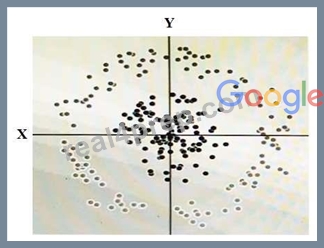
- A. cos(X)
- B. X^2+Y^2
- C. X^2
- D. Y^2
Answer: A
NEW QUESTION 134
Your company is using WHILECARD tables to query data across multiple tables with similar names. The SQL statement is currently failing with the following error:
# Syntax error : Expected end of statement but got "-" at [4:11] SELECT age FROM bigquery-public-data.noaa_gsod.gsod WHERE age != 99 AND_TABLE_SUFFIX = `1929' ORDER BY age DESC Which table name will make the SQL statement work correctly?
- A. `bigquery-public-data.noaa_gsod.gsod`
- B. bigquery-public-data.noaa_gsod.gsod*
- C. `bigquery-public-data.noaa_gsod.gsod'*
- D. `bigquery-public-data.noaa_gsod.gsod*`
Answer: B
NEW QUESTION 135
You are deploying MariaDB SQL databases on GCE VM Instances and need to configure monitoring and alerting. You want to collect metrics including network connections, disk IO and replication status from MariaDB with minimal development effort and use StackDriver for dashboards and alerts.
What should you do?
- A. Install the StackDriver Logging Agent and configure fluentd in_tail plugin to read MariaDB logs.
- B. Install the OpenCensus Agent and create a custom metric collection application with a StackDriver exporter.
- C. Install the StackDriver Agent and configure the MySQL plugin.
- D. Place the MariaDB instances in an Instance Group with a Health Check.
Answer: A
Explanation:
The GitHub repository named google-fluentd-catch-all-config which includes the configuration files for the Logging agent for ingesting the logs from various third-party software packages.
NEW QUESTION 136
Your company's on-premises Apache Hadoop servers are approaching end-of-life, and IT has decided to migrate the cluster to Google Cloud Dataproc. A like-for-like migration of the cluster would require 50 TB of Google Persistent Disk per node. The CIO is concerned about the cost of using that much block storage.
You want to minimize the storage cost of the migration. What should you do?
- A. Use preemptible virtual machines (VMs) for the Cloud Dataproc cluster.
- B. Put the data into Google Cloud Storage.
- C. Migrate some of the cold data into Google Cloud Storage, and keep only the hot data in Persistent Disk.
- D. Tune the Cloud Dataproc cluster so that there is just enough disk for all data.
Answer: A
Explanation:
Explanation/Reference:
Reference: https://cloud.google.com/dataproc/
NEW QUESTION 137
You create an important report for your large team in Google Data Studio 360. The report uses Google BigQuery as its data source. You notice that visualizations are not showing data that is less than 1 hour old. What should you do?
- A. Disable caching in BigQuery by editing table details.
- B. Refresh your browser tab showing the visualizations.
- C. Clear your browser history for the past hour then reload the tab showing the virtualizations.
- D. Disable caching by editing the report settings.
Answer: D
Explanation:
https://support.google.com/datastudio/answer/7020039?hl=en
NEW QUESTION 138
Your infrastructure includes a set of YouTube channels. You have been tasked with creating a process for sending the YouTube channel data to Google Cloud for analysis. You want to design a solution that allows your world-wide marketing teams to perform ANSI SQL and other types of analysis on up-to-date YouTube channels log data. How should you set up the log data transfer into Google Cloud?
- A. Use Storage Transfer Service to transfer the offsite backup files to a Cloud Storage Regional bucket as a final destination.
- B. Use BigQuery Data Transfer Service to transfer the offsite backup files to a Cloud Storage Regional storage bucket as a final destination.
- C. Use Storage Transfer Service to transfer the offsite backup files to a Cloud Storage Multi-Regional storage bucket as a final destination.
- D. Use BigQuery Data Transfer Service to transfer the offsite backup files to a Cloud Storage Multi- Regional storage bucket as a final destination.
Answer: D
NEW QUESTION 139
You are choosing a NoSQL database to handle telemetry data submitted from millions of Internet-of-Things (IoT) devices. The volume of data is growing at 100 TB per year, and each data entry has about 100 attributes. The data processing pipeline does not require atomicity, consistency, isolation, and durability (ACID). However, high availability and low latency are required. You need to analyze the data by querying against individual fields. Which three databases meet your requirements? (Choose three.)
- A. MySQL
- B. HBase
- C. HDFS with Hive
- D. Redis
- E. MongoDB
- F. Cassandra
Answer: B,C,E
NEW QUESTION 140
You are developing an application on Google Cloud that will automatically generate subject labels for users' blog posts. You are under competitive pressure to add this feature quickly, and you have no additional developer resources. No one on your team has experience with machine learning. What should you do?
- A. Call the Cloud Natural Language API from your application. Process the generated Entity Analysis as labels.
- B. Build and train a text classification model using TensorFlow. Deploy the model using a Kubernetes Engine cluster. Call the model from your application and process the results as labels.
- C. Call the Cloud Natural Language API from your application. Process the generated Sentiment Analysis as labels.
- D. Build and train a text classification model using TensorFlow. Deploy the model using Cloud Machine Learning Engine. Call the model from your application and process the results as labels.
Answer: A
NEW QUESTION 141
Data Analysts in your company have the Cloud IAM Owner role assigned to them in their projects to allow them to work with multiple GCP products in their projects. Your organization requires that all BigQuery data access logs be retained for 6 months. You need to ensure that only audit personnel in your company can access the data access logs for all projects. What should you do?
- A. Enable data access logs in each Data Analyst's project. Restrict access to Stackdriver Logging via Cloud IAM roles.
- B. Export the data access logs via an aggregated export sink to a Cloud Storage bucket in a newly created project for audit logs. Restrict access to the project that contains the exported logs.
- C. Export the data access logs via a project-level export sink to a Cloud Storage bucket in the Data Analysts' projects. Restrict access to the Cloud Storage bucket.
- D. Export the data access logs via a project-level export sink to a Cloud Storage bucket in a newly created projects for audit logs. Restrict access to the project with the exported logs.
Answer: B
Explanation:
https://cloud.google.com/iam/docs/roles-audit-logging#scenario_external_auditors
NEW QUESTION 142
Which is the preferred method to use to avoid hotspotting in time series data in Bigtable?
- A. Field promotion
- B. Randomization
- C. Hashing
- D. Salting
Answer: A
Explanation:
By default, prefer field promotion. Field promotion avoids hotspotting in almost all cases, and it tends to make it easier to design a row key that facilitates queries.
Reference: https://cloud.google.com/bigtable/docs/schema-design-time-
series#ensure_that_your_row_key_avoids_hotspotting
NEW QUESTION 143
......
Understanding functional and technical aspects of Google Professional Data Engineer Exam Ensuring solution quality
The following will be discussed here:
- Assessing, troubleshooting, and improving data representations and data processing infrastructure
- Identity and access management (e.g.,Cloud IAM)
- Data security (encryption, key management)
- Performing data preparation and quality control (e.g., Cloud Dataprep)
- Data staging, cataloging, and discovery
- Ensuring scalability and efficiency
- Choosing between ACID, idempotent, eventually consistent requirements
- Legal compliance (e.g., Health Insurance Portability and Accountability Act (HIPAA), Children’s Online Privacy Protection Act (COPPA), FedRAMP, General Data Protection Regulation (GDPR))
- Resizing and autoscaling resources
- Planning, executing, and stress testing data recovery (fault tolerance, rerunning failed jobs, performing retrospective re-analysis)
- Mapping to current and future business requirements
- Designing for data and application portability (e.g., multi-cloud, data residency requirements)
- Pipeline monitoring (e.g., Stackdriver)
- Building and running test suites
- Ensuring privacy (e.g., Data Loss Prevention API)
- Ensuring flexibility and portability
- Verification and monitoring
- Designing for security and compliance
- Ensuring reliability and fidelity
Build & Operationalize Data Processing Systems
- Build & Operationalize Processing Infrastructure: The considerations for this subject area include provisioning resources, adjusting pipeline, monitoring pipeline, and testing & quality control.
- Build & Operationalize Pipeline: This module requires that the learners demonstrate competence in data cleansing, transformation, batch & streaming, data import & acquisition, as well as integration with the new data sources;
- Build & Operationalize Storage Systems: This part will require the students’ skills and competence in the effective usage of managed services, including Cloud Spanner, CLoug Bigtable, BigQuery, Cloud SQL, Cloud Memorystore, Cloud Datastore, and Cloud Storage. It also covers their skills in managing the data lifecycle and storage performance and costs;
Professional-Data-Engineer Practice Test Pdf Exam Material: https://www.real4prep.com/Professional-Data-Engineer-exam.html
Professional-Data-Engineer Questions Pass on Your First Attempt Dumps for Google Cloud Certified Certified: https://drive.google.com/open?id=1SLqiWttk9jne0ADG7dmS2vbb0QjJjOte